Custom EVA makeup bag,
beautiful enough to raise your price.
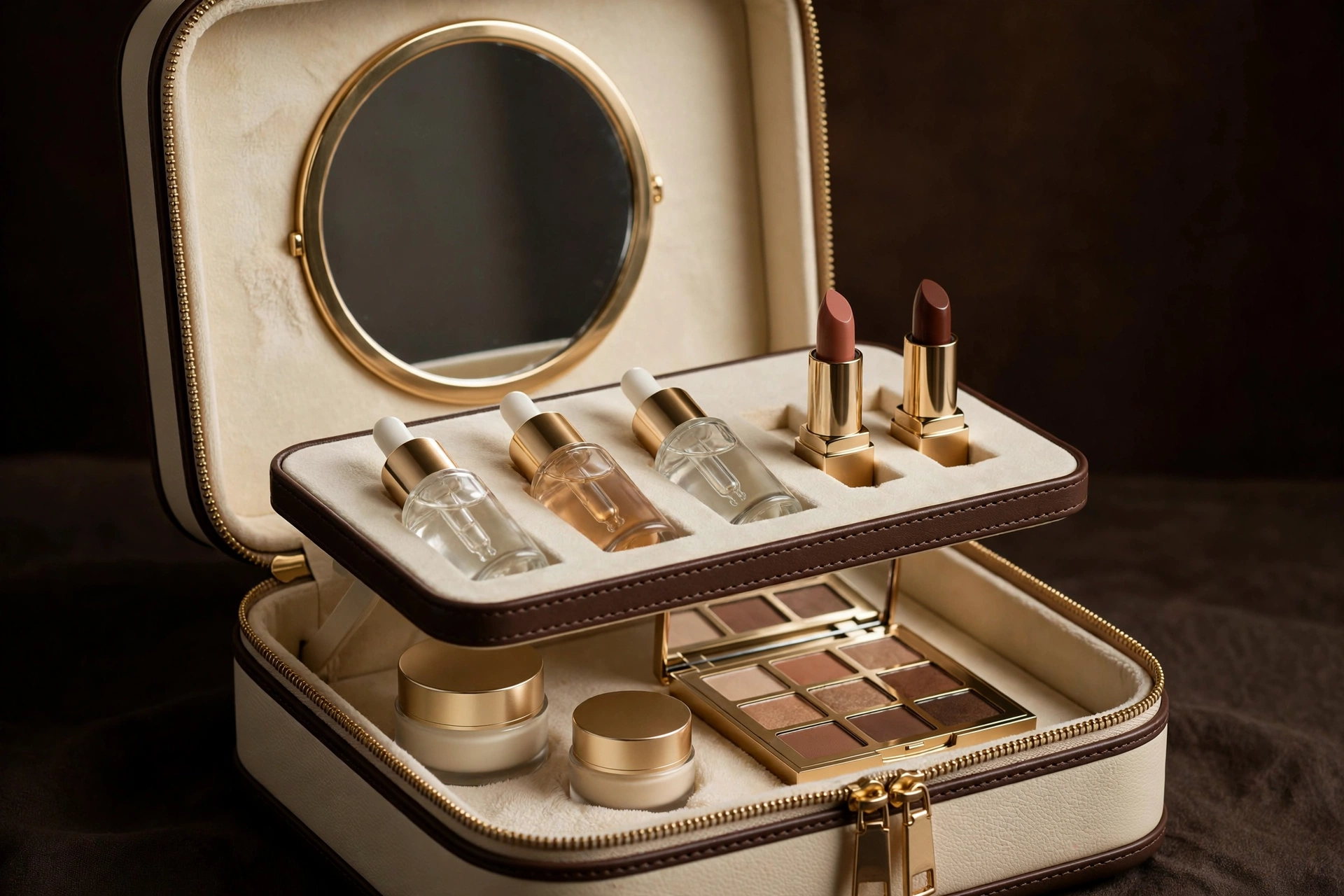
Eight products, two tiers, one mirror. A lift-out tray for serums and lipsticks, a lower deck for creams and palettes, a vanity mirror in the lid — in oat-cream and espresso with champagne-gold zippers. This case doesn't just hold a $60 set. It sells it as a $120 gift. That's what packaging is for.
- 8 die-cut cavities
- 2-tier lift-out tray
- Mirror in lid
- Custom MOQ 1,000 pcs
The four ways beauty packaging
usually goes wrong.
A makeup case has two jobs: protect the glass, and honor the price tag. Most fail the second.
"Glass bottles arrive broken — and we pay for it."
A serum bottle rattling in a generic insert is a breakage claim waiting to happen. Our answer: every bottle gets its own die-cut cradle, held at neck and base — zero movement in any direction, inside a rigid shell that absorbs drops before they reach the glass.
"The set looks cheaper than its price."
A $60 formula in a $2 pouch tells the customer the brand doesn't believe in itself. Our answer: oat-cream & espresso two-tone, champagne-gold zippers, microfiber lining — the unboxing feels like a $120 gift. Packaging is margin.
"The sample was beautiful. The bulk order wasn't."
Hand-finished samples that factories can't repeat at volume. Our answer: the sample is cut on the same die-cut tooling as production — what you approve is what 1,000 pcs look like.
"Powder compacts arrive scratched and dusty."
Hard foam edges and gritty lining mark mirrors and compacts. Our answer: microfiber lining on every product-touching surface — nothing hard ever touches your product.
Pull it apart.
See what you're paying for.
Seven layers. Tap each number — every layer answers one of the seven fit-engineering questions: volume, size, protection, rattle, lift, scratch, static.
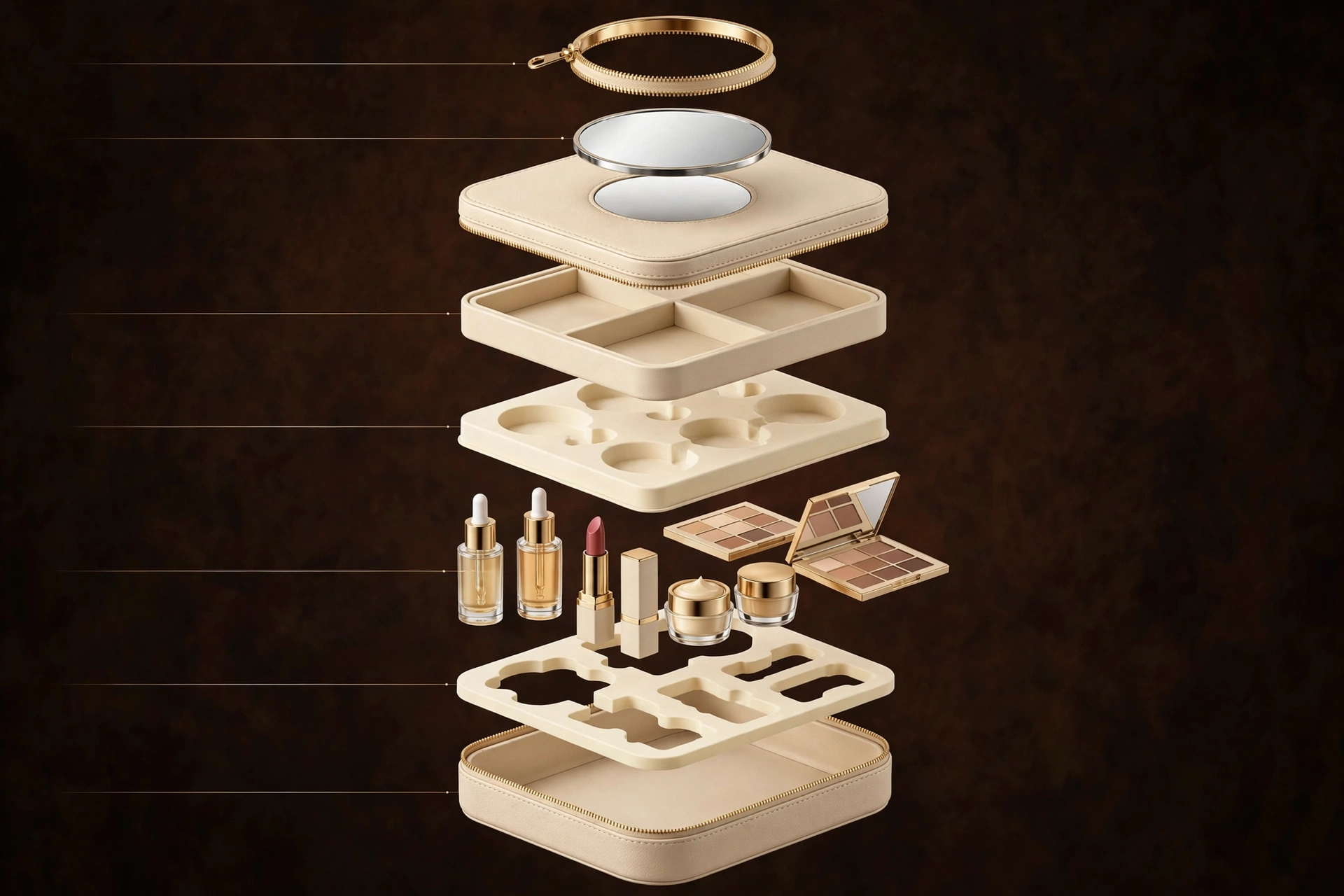
1 · Champagne-gold zipper
Jewelry-grade metal zipper — the first thing a customer touches. Hardware is where cheap cases reveal themselves; this one is specified like jewelry, tested for thousands of cycles.
The details that raise the price tag.
Three close-ups. Protection is the baseline — these are the details customers pay extra for.
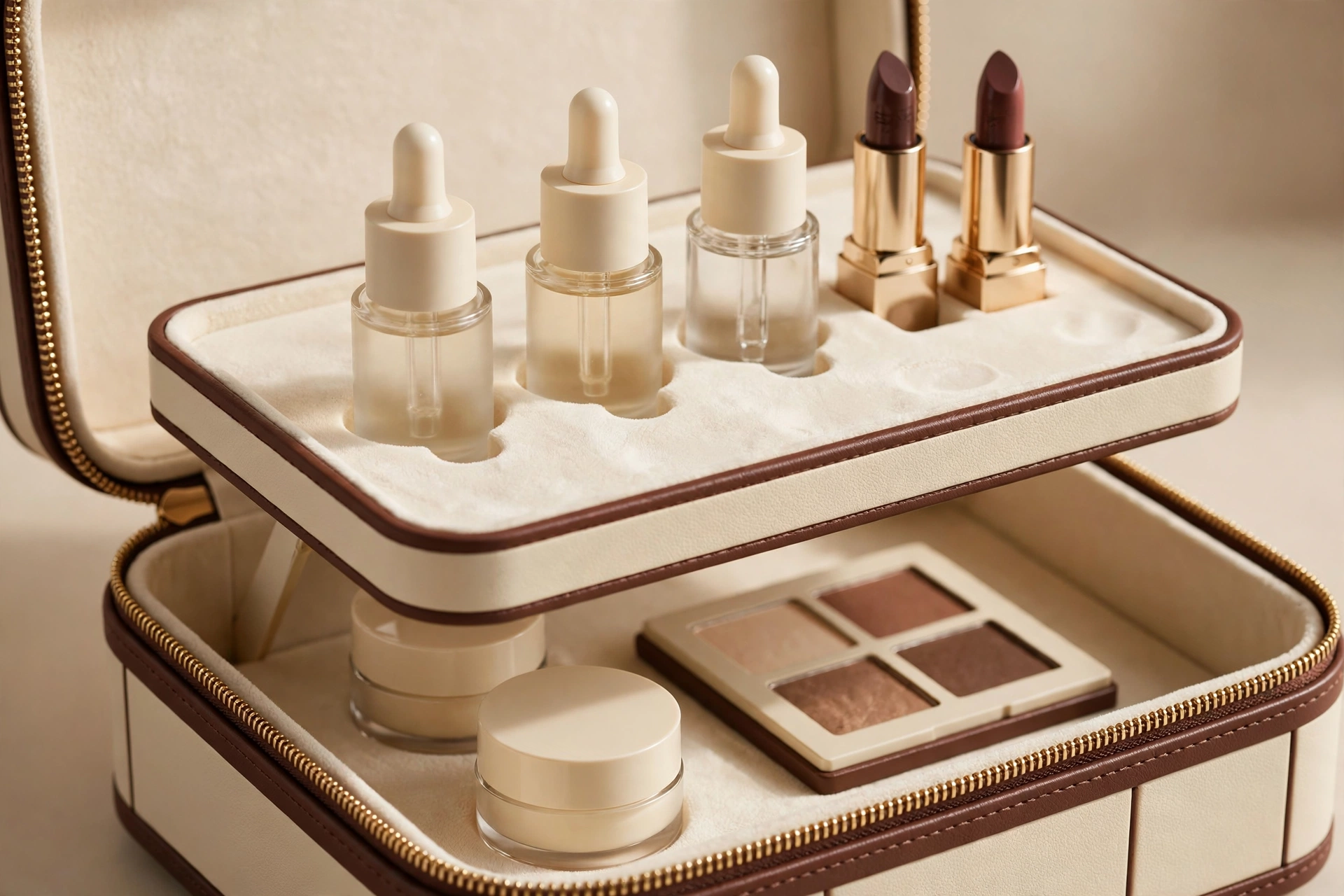
Lift-out tray, zero wobble
The hard part, made to look easy. A rigid tray that lifts out on hidden supports — toleranced to slide smoothly for years, never wobble, never jam.
- Upper deck: 3 serums + 2 lipsticks in die-cut slots
- Lower deck: 2 cream jars + palette, revealed in one lift
- Tray edge bound in espresso — no raw foam anywhere
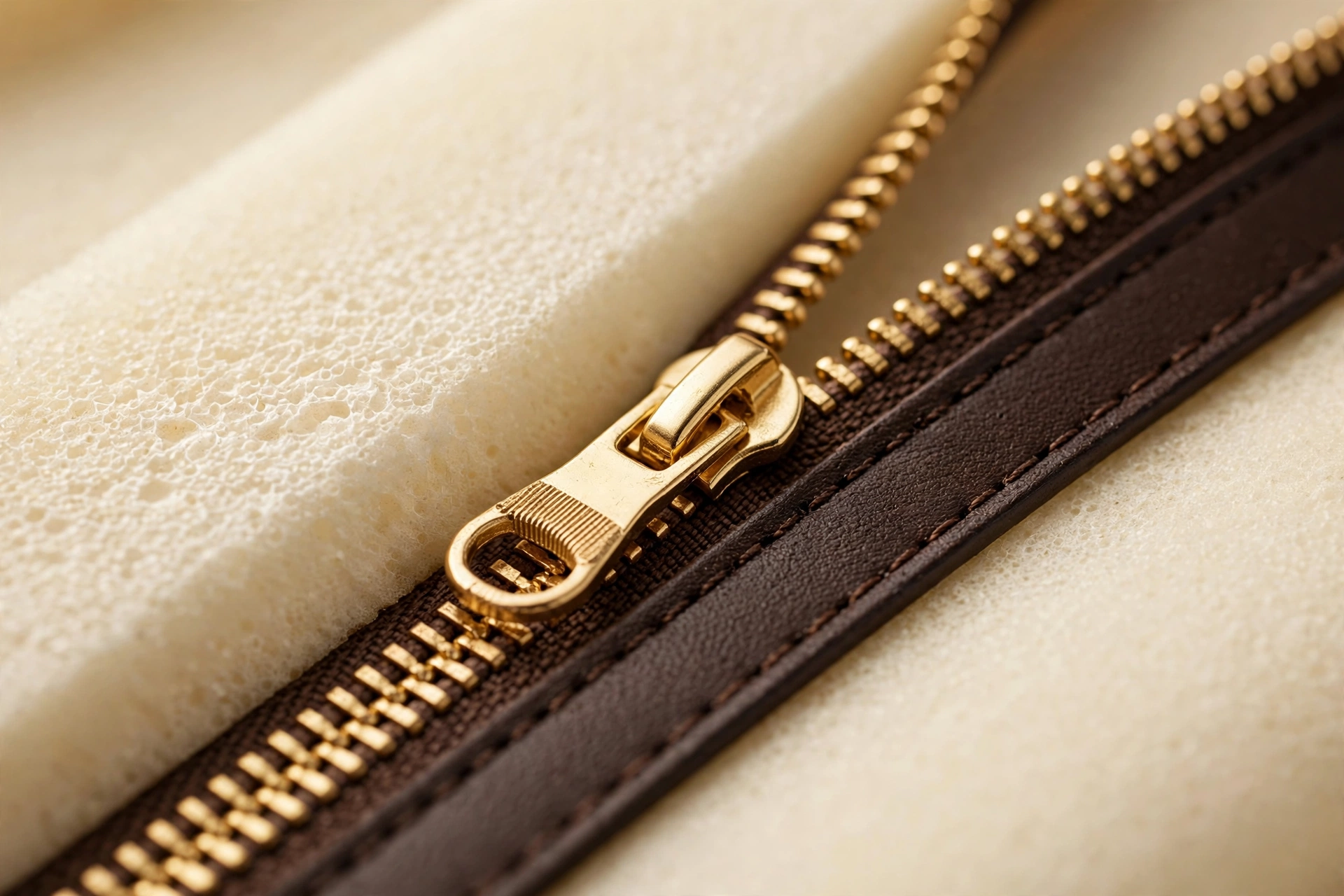
Champagne-gold zipper, fine stitching
This is the margin detail. A champagne-gold metal zipper on oat-cream reads "gift" before the case is even open — hardware specified like jewelry, not like luggage.
- Metal zipper in champagne gold, rose-gold or nickel — your call
- Stitching matched to shell color, edge-finished
- Pulls weighted to feel expensive in the hand
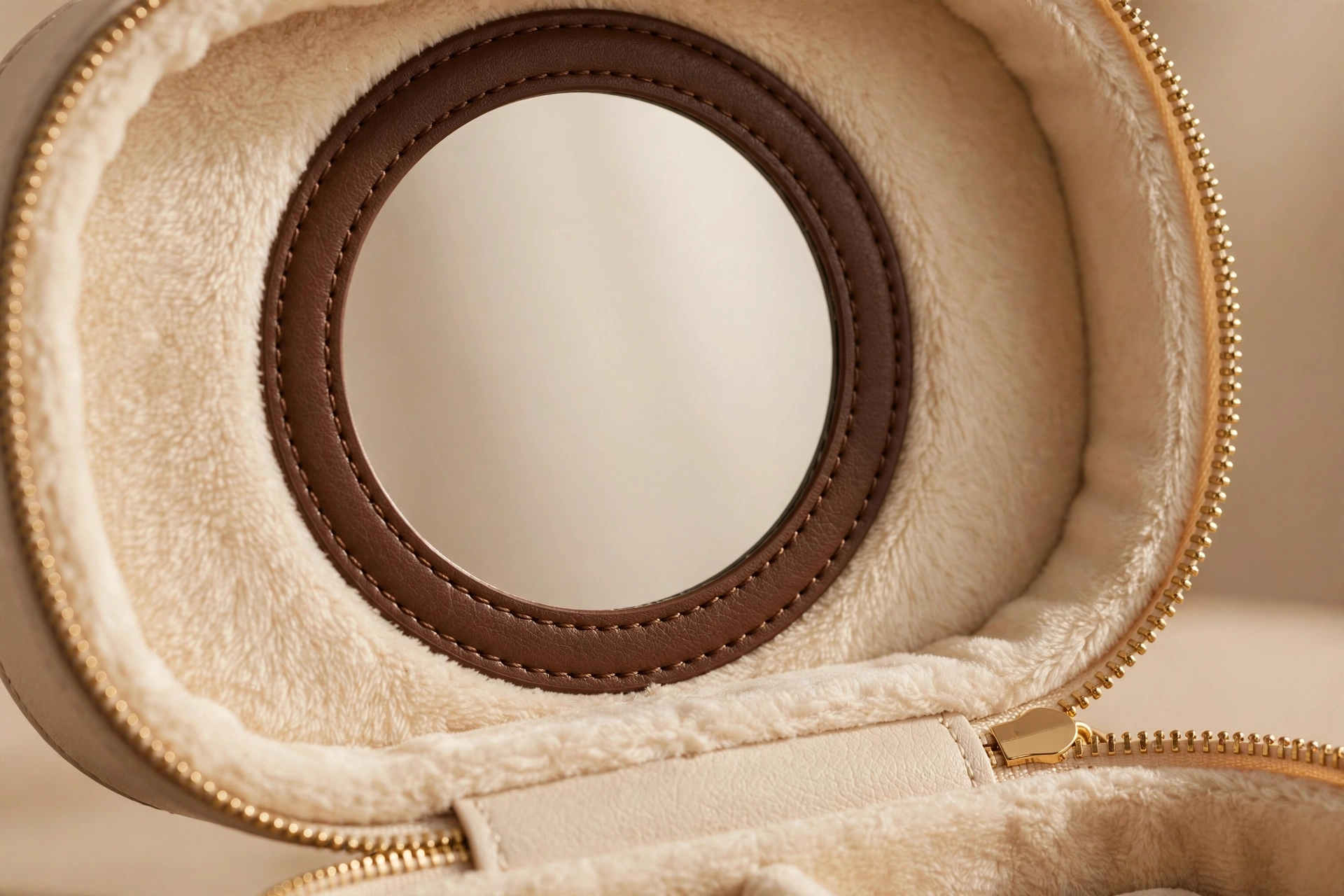
Vanity mirror, set in the lid
The case becomes the vanity. A real glass mirror, seated in espresso trim — engineered so it never rattles, never pops, even when the case takes a hit.
- Glass mirror, not plastic — distortion-free reflection
- Seated in a toleranced recess with shock-absorbing bed
- Turns unboxing into a ritual — the premium moment
Picked to protect glass
and justify price.
Every material here serves two masters: the product inside, and the customer's willingness to pay.
- Shell — molded EVA, oat-cream & espresso
- Why: two-tone quiet luxury — the fashion signal. Heat-pressed seamless, cut and bound as one piece so no trim ever peels.
- Tray — rigid EVA, lift-out
- Why: the mechanism is the moat. A toleranced tray that glides for years separates engineered cases from glued ones.
- Inserts — die-cut EVA, 8 cavities
- Why: each cavity is a perfect negative of its product. Zero rattle, zero lift, minimum case volume — you stop paying freight for air.
- Mirror — glass, lid-set
- Why: turns the case into a vanity. Real glass, shock-bedded — plastic mirrors scratch and distort, and customers notice.
- Zippers — champagne-gold metal
- Why: the premium signal. Gold hardware is what separates a $12 case from a $40 case in the customer's hand.
- Lining — cream microfiber
- Why: the only thing touching glass and compacts. Soft, lint-free, non-abrasive — foam alone would eventually mark surfaces.
Every beauty product deserves
its own case.
Not "a makeup bag" — a case designed for one product, that makes that product feel worth more. Find yours.
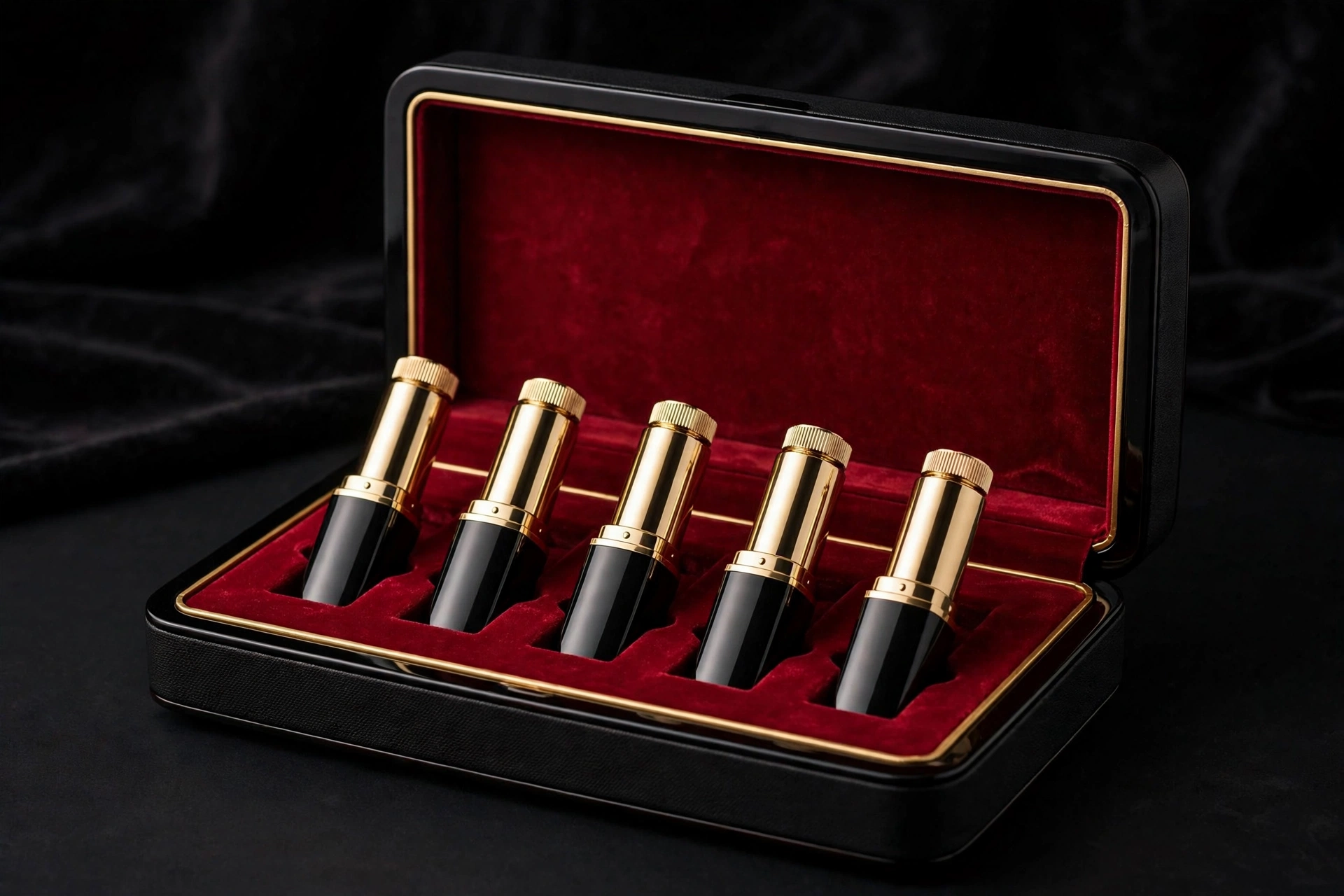
Lipstick coffret
Black lacquer · red velvet · gifting grade
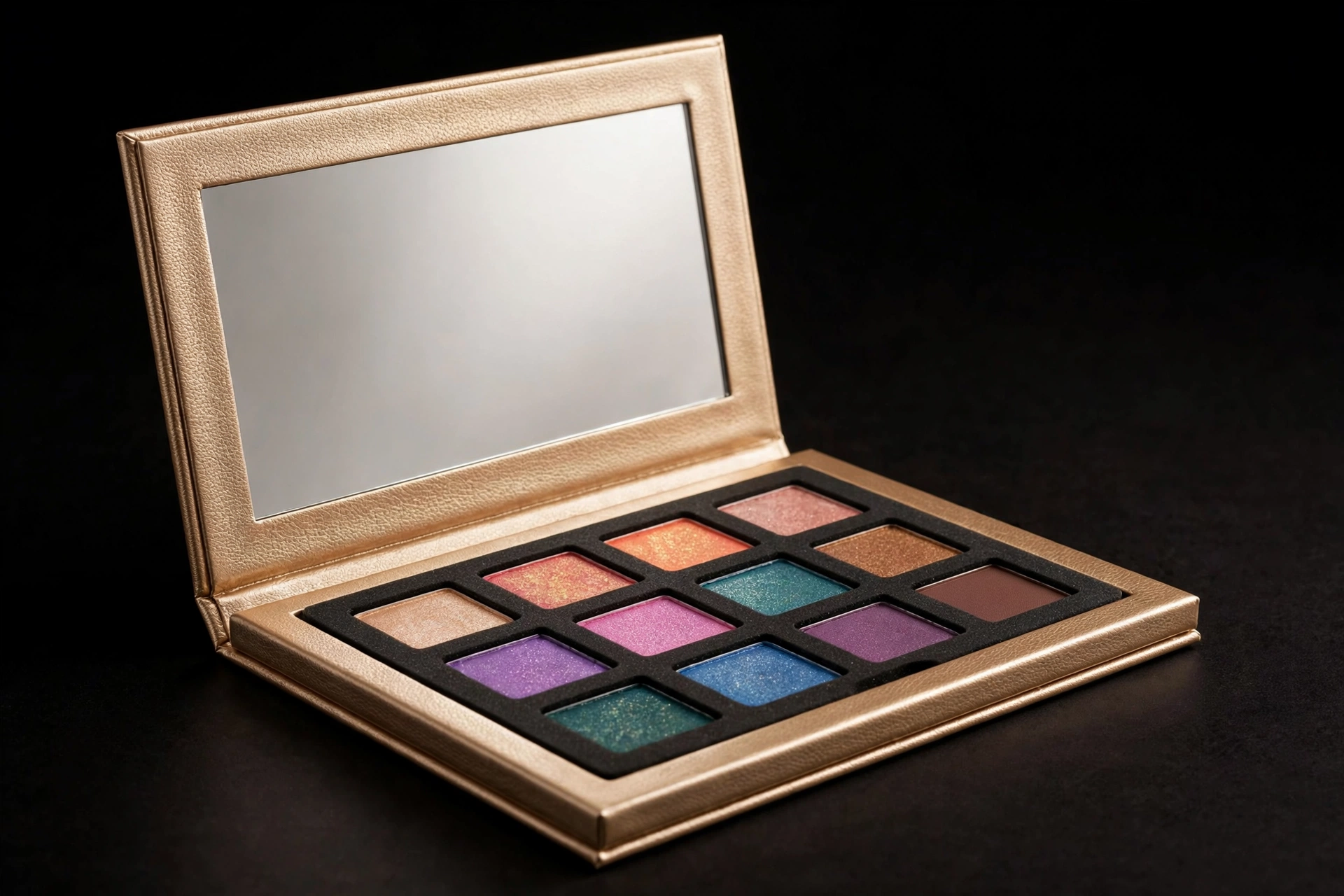
Eyeshadow palette
Champagne gold · mirror lid · slim profile
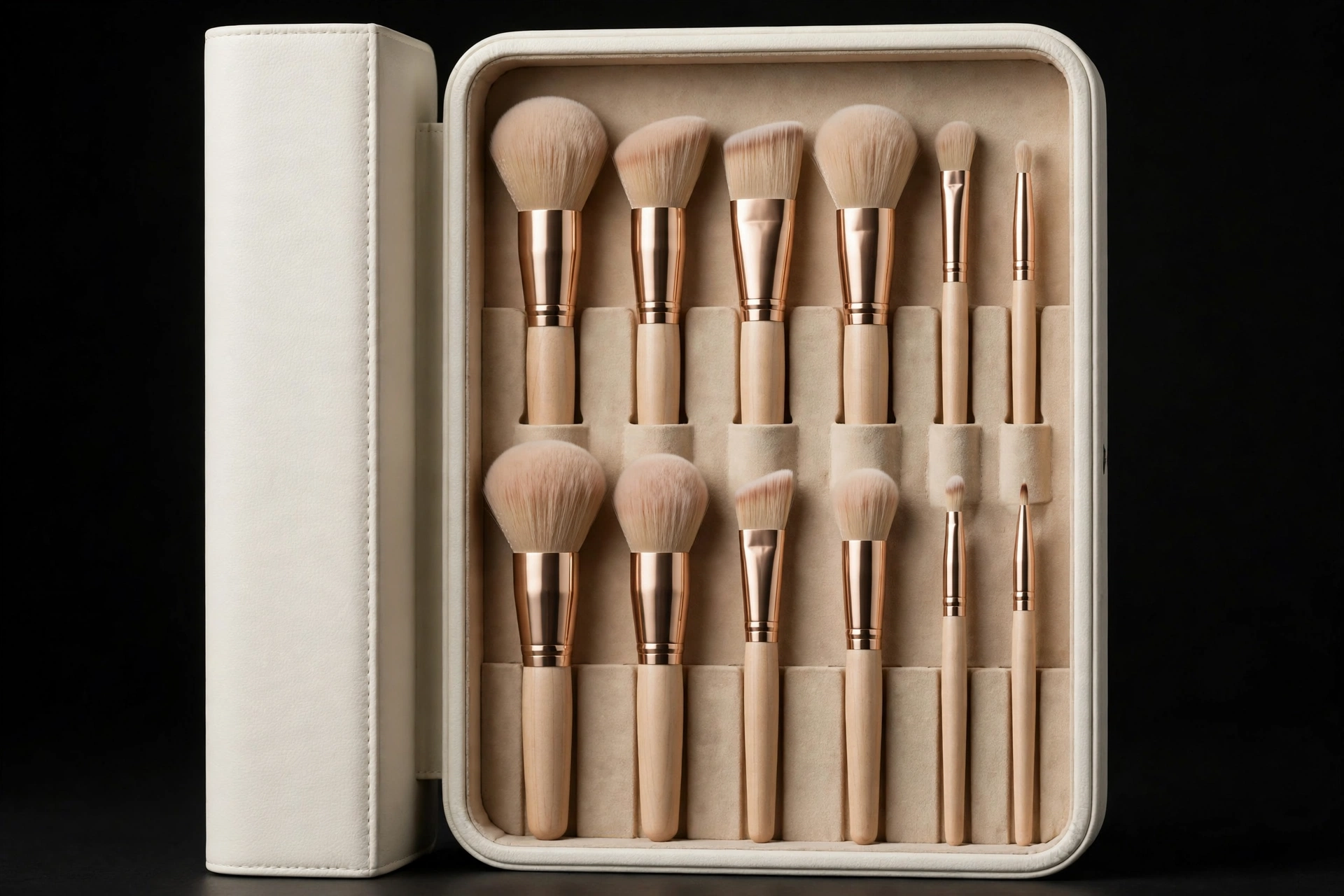
Brush set
Ivory shell · 12 upright slots · pro kit
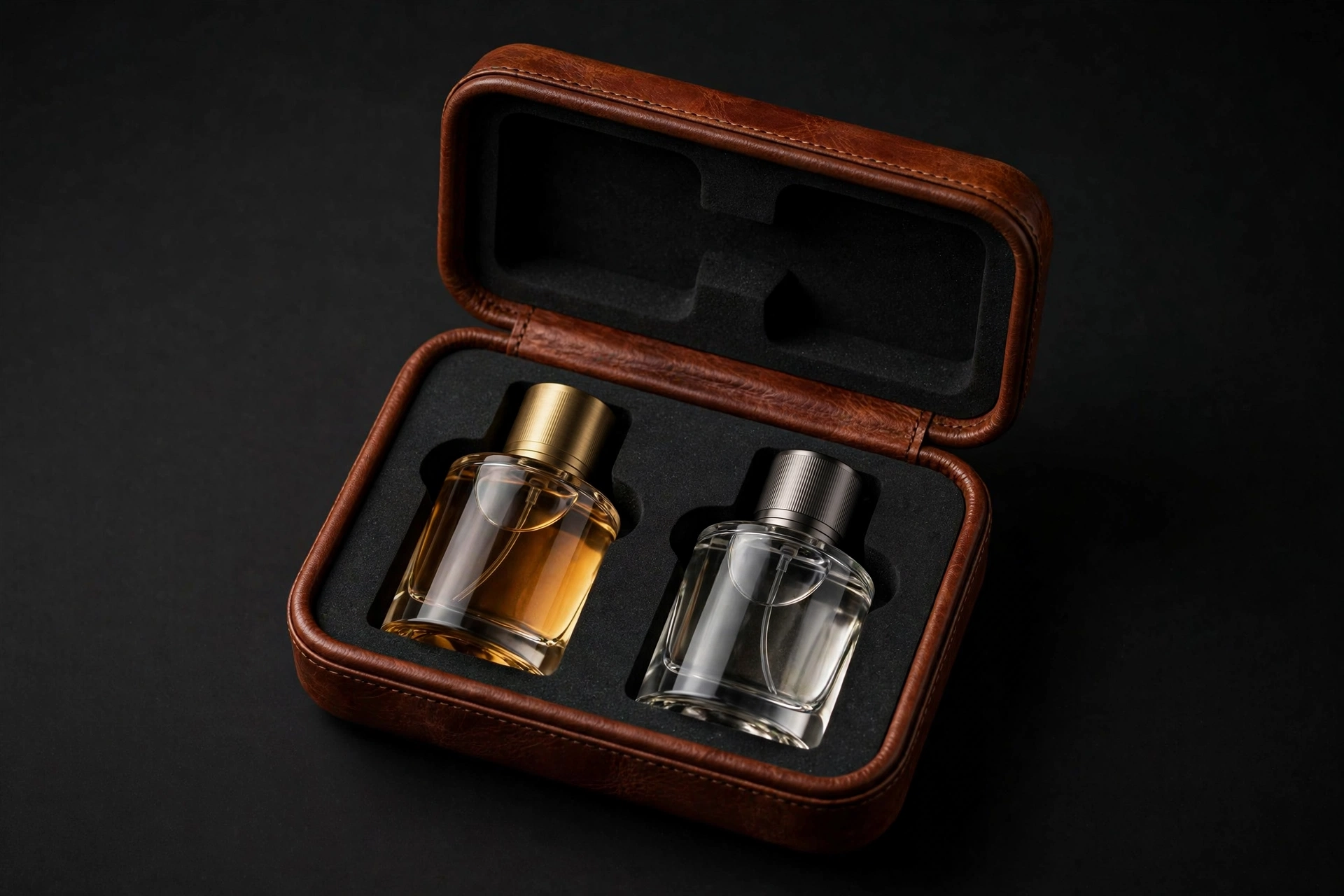
Fragrance travel
Cognac trim · twin bottles · unisex
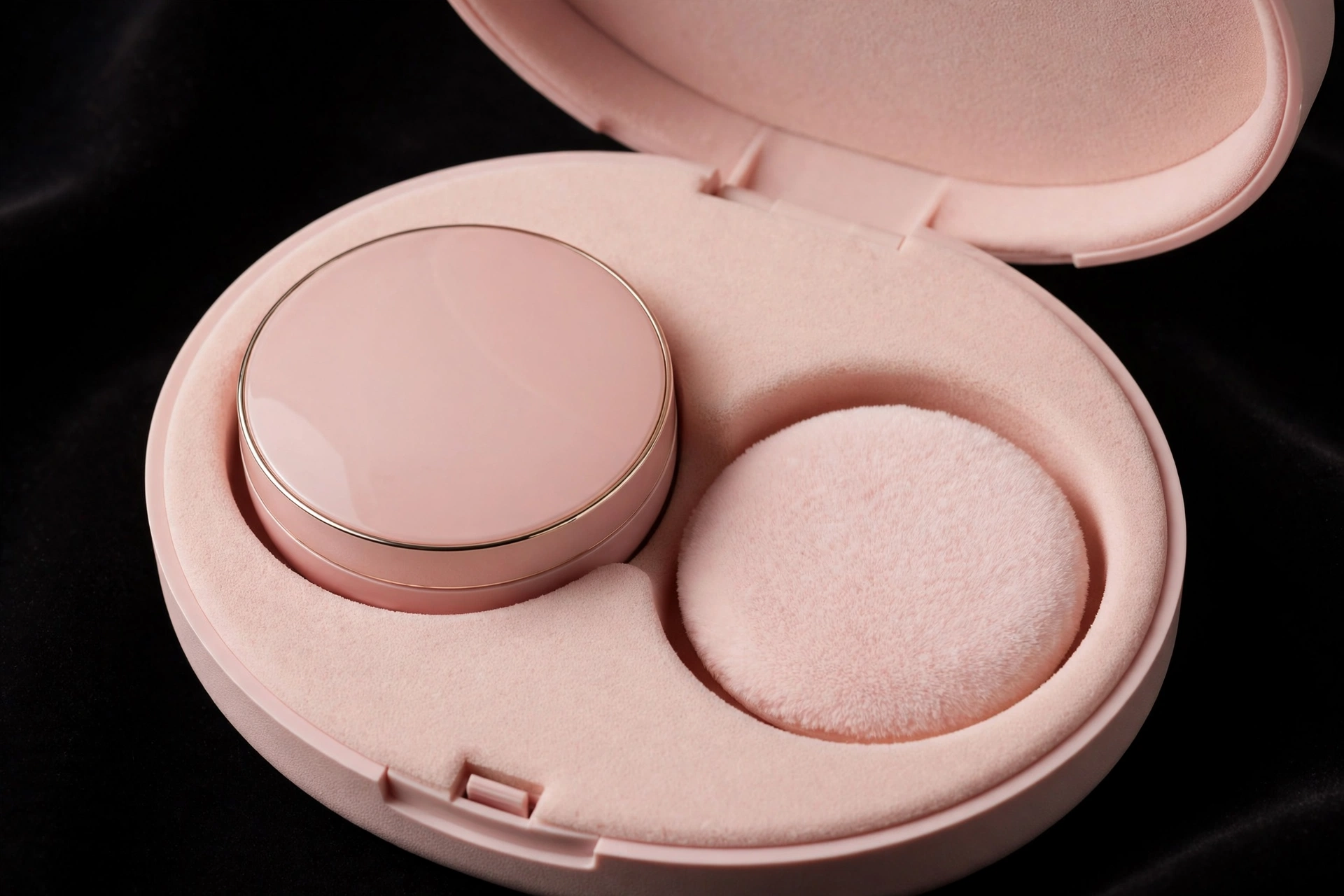
Cushion compact
Round form · puff well · purse size
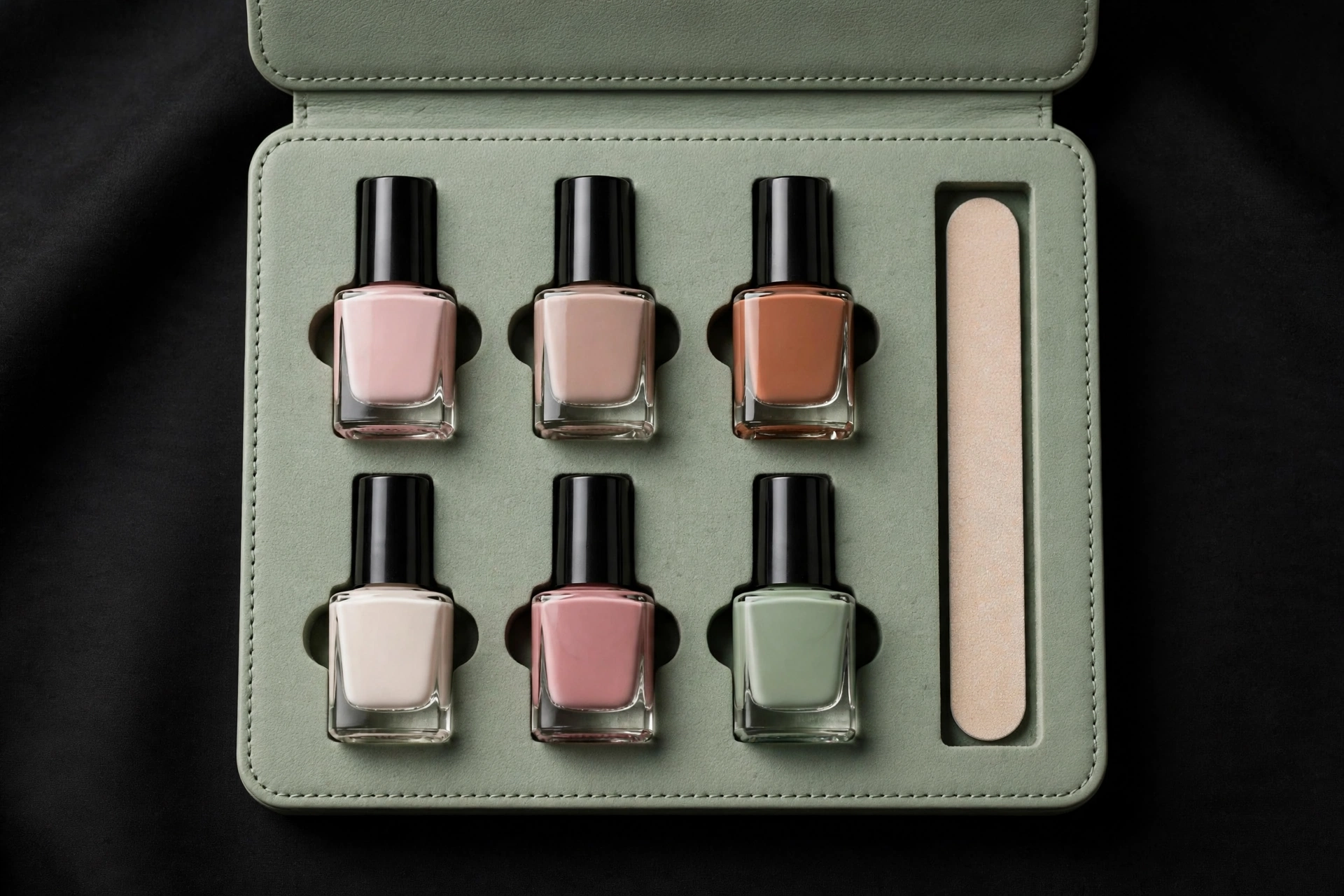
Nail kit
Sage green · polish slots · flat pack
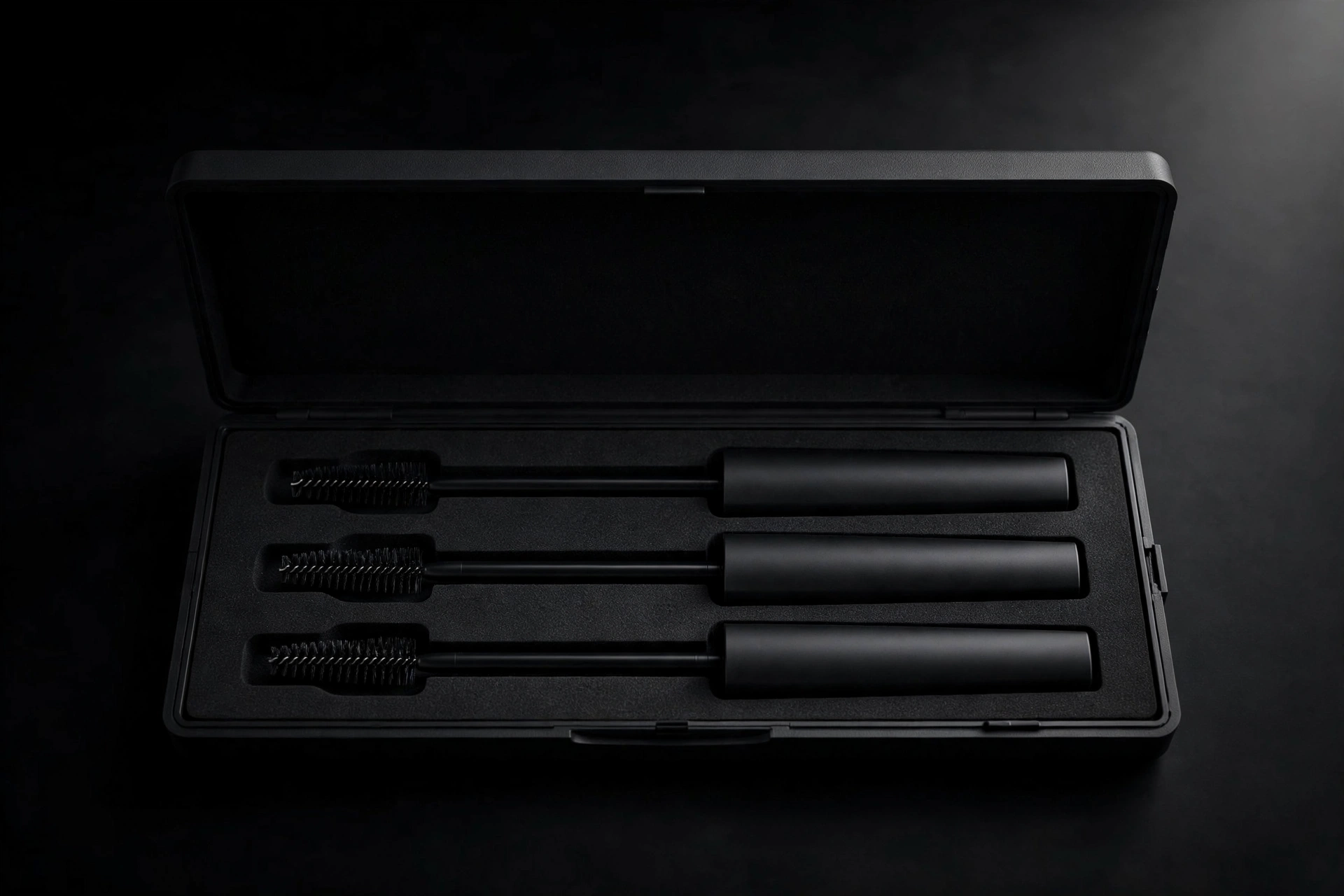
Mascara set
Matte black · triple channels · minimal
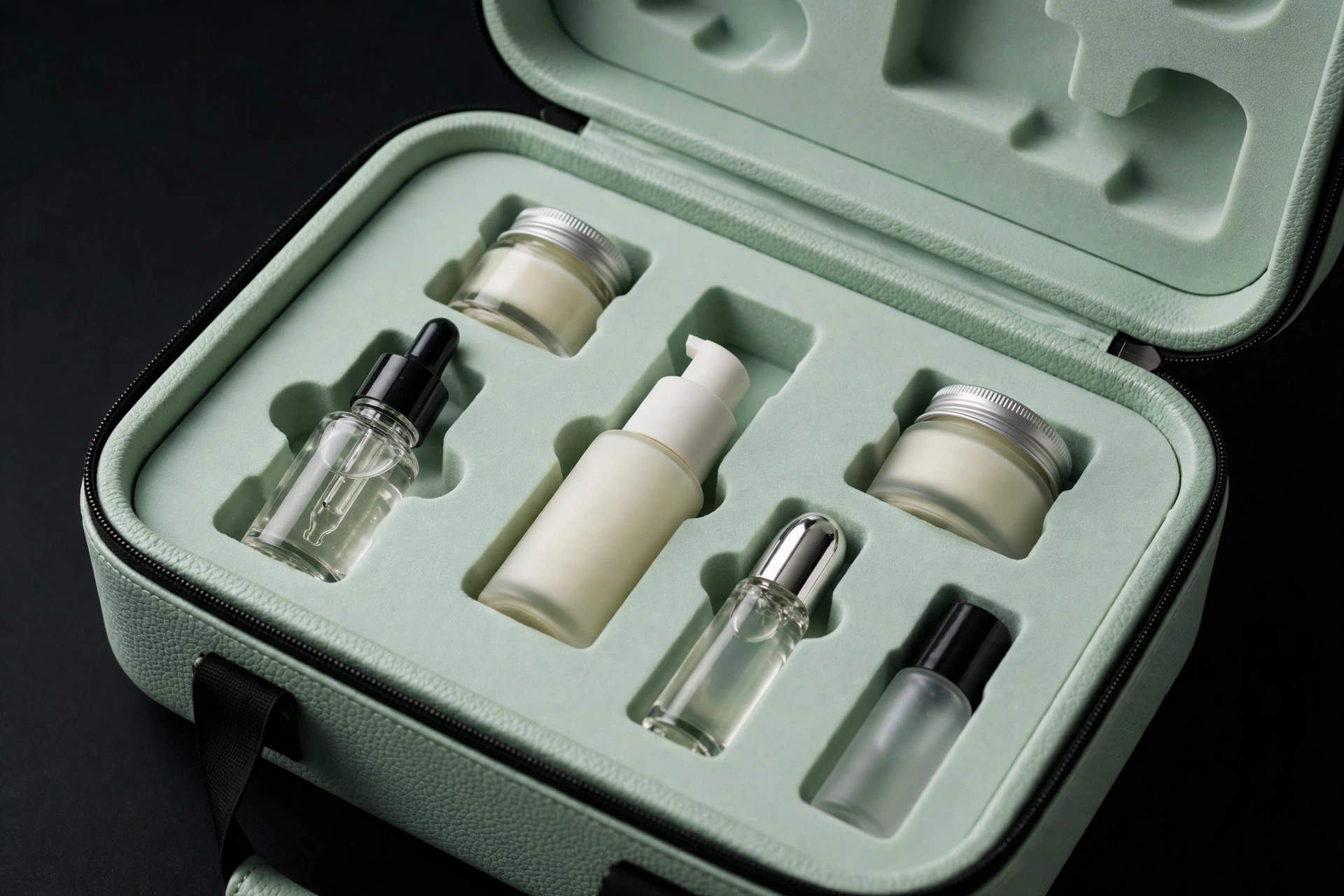
Skincare minis
Mint shell · travel set · clean beauty
You don't need to know packaging.
Just tell us about your product.
Three questions about your product, its life, your brand — then we prescribe the build that raises its price tag.
What decides your case price.
We don't hide behind "contact for quote." Here are the four levers — tell us where you stand on each and the quote writes itself.
Case size & shape
Bigger shell, more material, more freight. A die-cut insert trimmed to your set — not a generic box — is the cheapest freight you'll ever pay.
Insert complexity
Number of cavities, tolerance, lining. Four bottle cradles at ±0.3mm cost more than one open compartment — and break fewer bottles.
Materials & hardware
Gold metal zippers, velvet lining, leather trim — each is a premium signal with a price. We spec the finish to your target retail price.
Quantity
Custom starts at 1,000 pcs. Unit cost falls as volume rises — tooling is amortized, not repeated.
Five questions to ask any EVA factory.
Including us. Take this list to every supplier you evaluate — the answers tell you who actually engineers the fit.
- 1 · How do you verify die-cut tolerance?
- Good answer: caliper-checked against your product CAD, cavity by cavity. Red flag: "our standard sizes fit most products."
- 2 · Is the sample cut on production tooling?
- Good answer: yes — the sample die becomes the production die. Red flag: hand-cut samples that can't be repeated at volume.
- 3 · How do you test for glass?
- Good answer: drop testing with your actual bottles inside, checking for rattle in all directions. Red flag: no test, just "EVA is soft."
- 4 · What touches my product?
- Good answer: a named lining — microfiber, velvet, flannel — on every product surface. Red flag: raw foam edges against glass.
- 5 · What is the zipper rated for?
- Good answer: a cycle count and a supplier spec. Red flag: "high quality zippers" with no number.
Numbers, not adjectives.
- Custom MOQ
- 1,000 pcs — real custom work starts here
- Sampling
- ~7 days — physical sample in your hands
- Mass production
- 15–25 days after sample approval
- Monthly capacity
- 100k+ pcs across 3 production lines
Asked by beauty brands
An EVA makeup bag is a hard-shell cosmetic case made from heat-pressed EVA foam, with die-cut compartments shaped to the exact dimensions of bottles, jars and compacts — so glass never rattles, shifts or touches anything hard.
Each bottle gets its own die-cut cradle holding it at the neck and base — zero movement in any direction — inside a rigid shell that absorbs drops before they reach the glass.
Yes — shell color, lining, zipper finish and logo treatment (debossed, foil or printed) are all specified from your brand guidelines.
That's the point. Tell us your target retail price and we'll spec the finish to match it — hardware, lining and trim are chosen to justify the price tag, not just to hold the product.
Typically 1,000 pcs. Samples in ~7 days, production 15–25 days after your approval.
Send us your product.
We'll make it worth more.
Dimensions, 3D files, or the actual bottles — engineering feedback and a quote within 24 hours.
info@hcdcase.com