Custom EVA glasses case,
beautiful enough to raise your price.
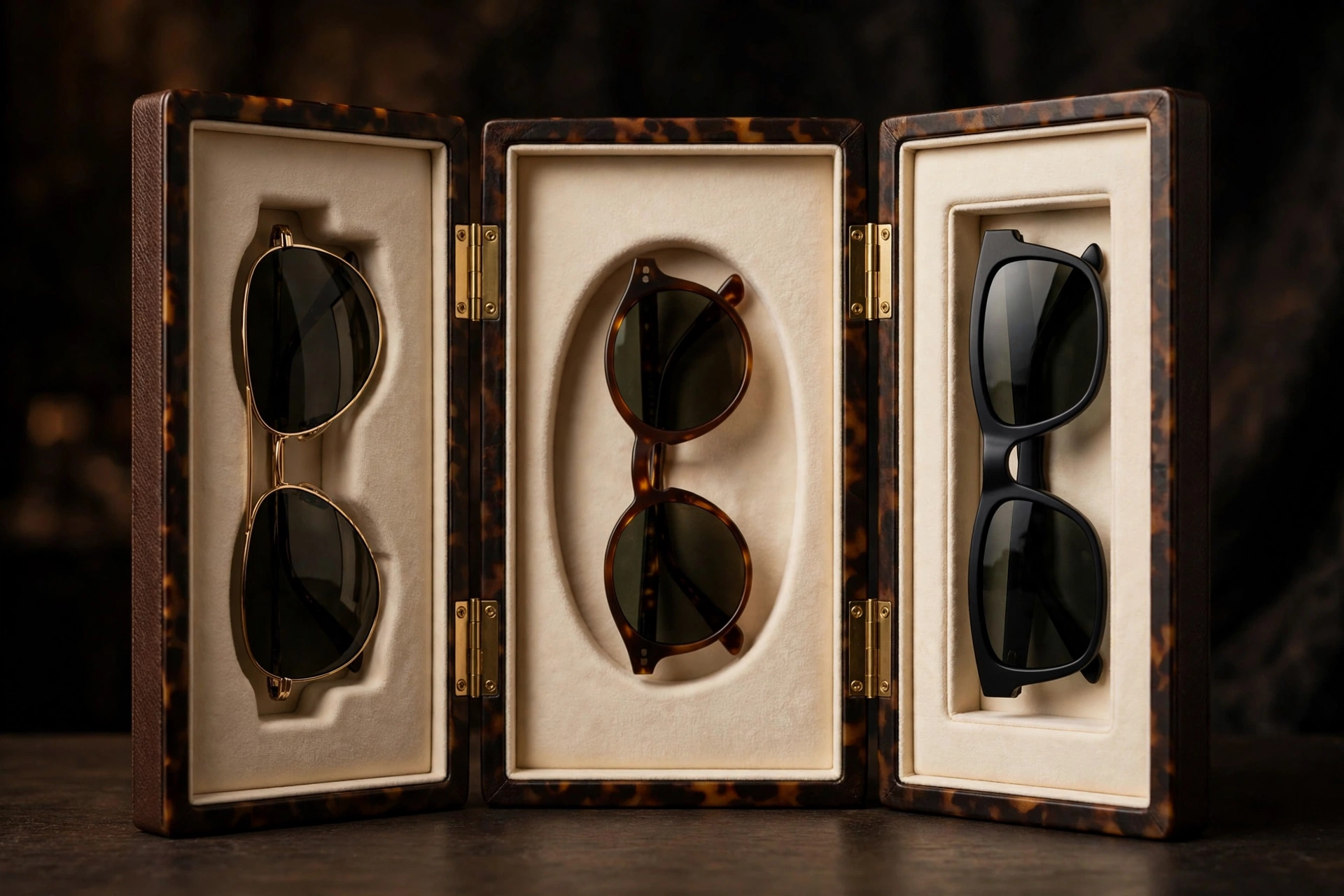
Three pairs, three cavities, one display. A tri-fold case that opens like a triptych and stands on the counter — aviator, round and rectangular, each nested in its own recessed microfiber cradle, in tortoise EVA with brass hinges. Folds flat, closes with a brass clasp. This case doesn't just hold a $100 frame. It sells it as a $200 gift. That's what packaging is for.
- 3 pairs, 3 cavities
- Tri-fold display
- Brass hinges & clasp
- Custom MOQ 1,000 pcs
The four ways eyewear packaging
usually goes wrong.
A glasses case has two jobs: protect the lens, and honor the price tag. Most fail the second.
"Lenses arrive scratched — and customers blame the frame."
A lens touching hard foam or another frame is a scratch claim waiting to happen. Our answer: every pair gets its own microfiber cradle — the lens touches nothing but soft lining, in a rigid shell that absorbs drops before they reach the glass.
"The frame looks cheaper than its price."
A $100 frame in a $2 pouch tells the customer the brand doesn't believe in itself. Our answer: tortoise EVA, brass hinges and clasp, cream microfiber — the unboxing feels like a $200 gift. Packaging is margin.
"One cavity fits the aviator but crushes the round frame."
Generic slots are designed for nobody's frame. Our answer: each cavity is cut for one specific frame shape — aviator, round, rectangular each get their own negative. No forcing, no pressure on hinges.
"Our display looks like everyone else's."
Eyewear is fashion — it sells from the counter, not from a drawer. Our answer: the case opens into a standing triptych display — your three hero frames presented like art, on any retail counter.
Pull it apart.
See what you're paying for.
Five layers. Tap each number — every layer answers one of the seven fit-engineering questions: volume, size, protection, rattle, lift, scratch, static.
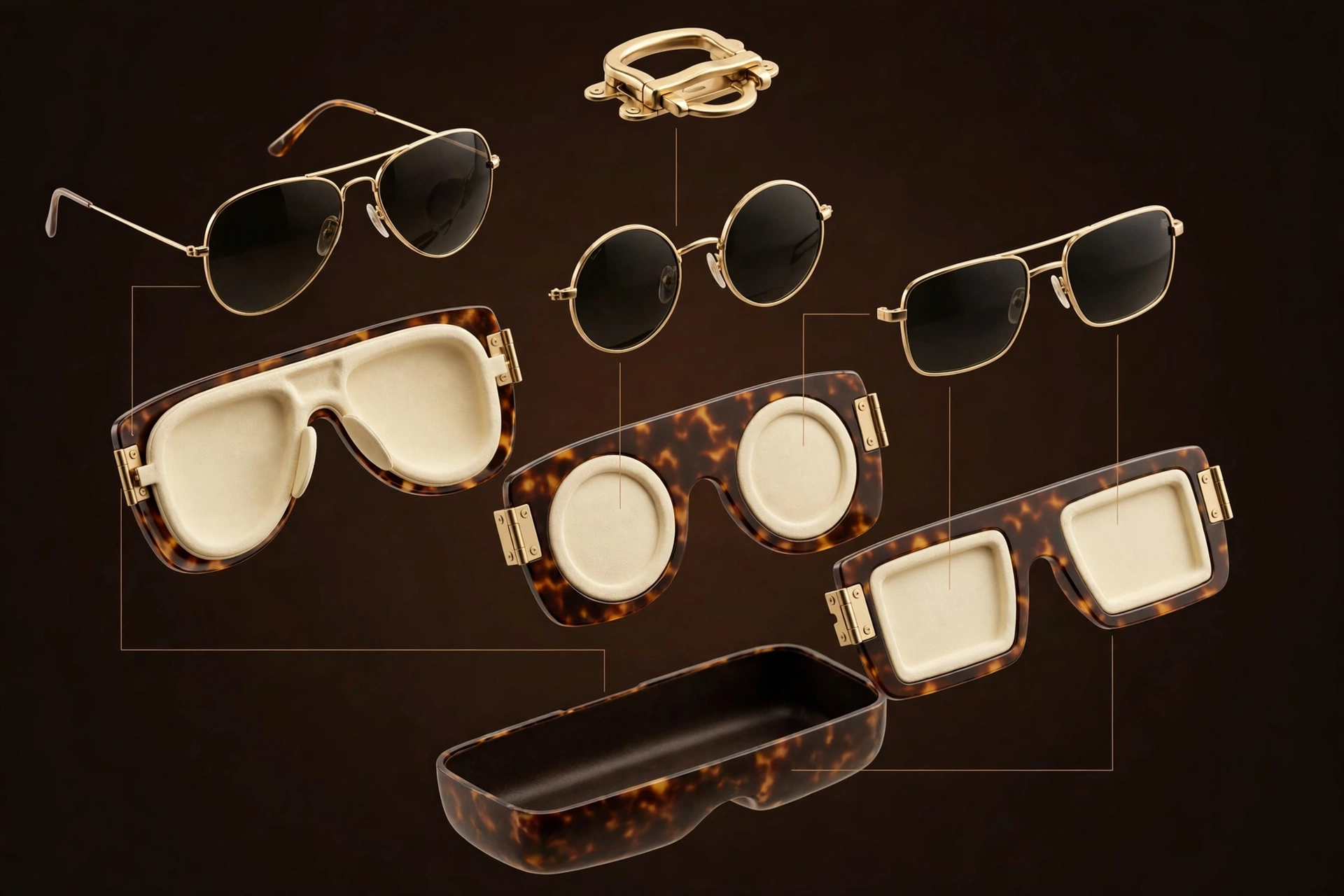
1 · Brass clasp
Jewelry-grade brass clasp — the first thing a customer touches. Hardware is where cheap cases reveal themselves; this one is specified like a watch buckle, tested for thousands of cycles.
The details that raise the price tag.
Three close-ups. Protection is the baseline — these are the details customers pay extra for.
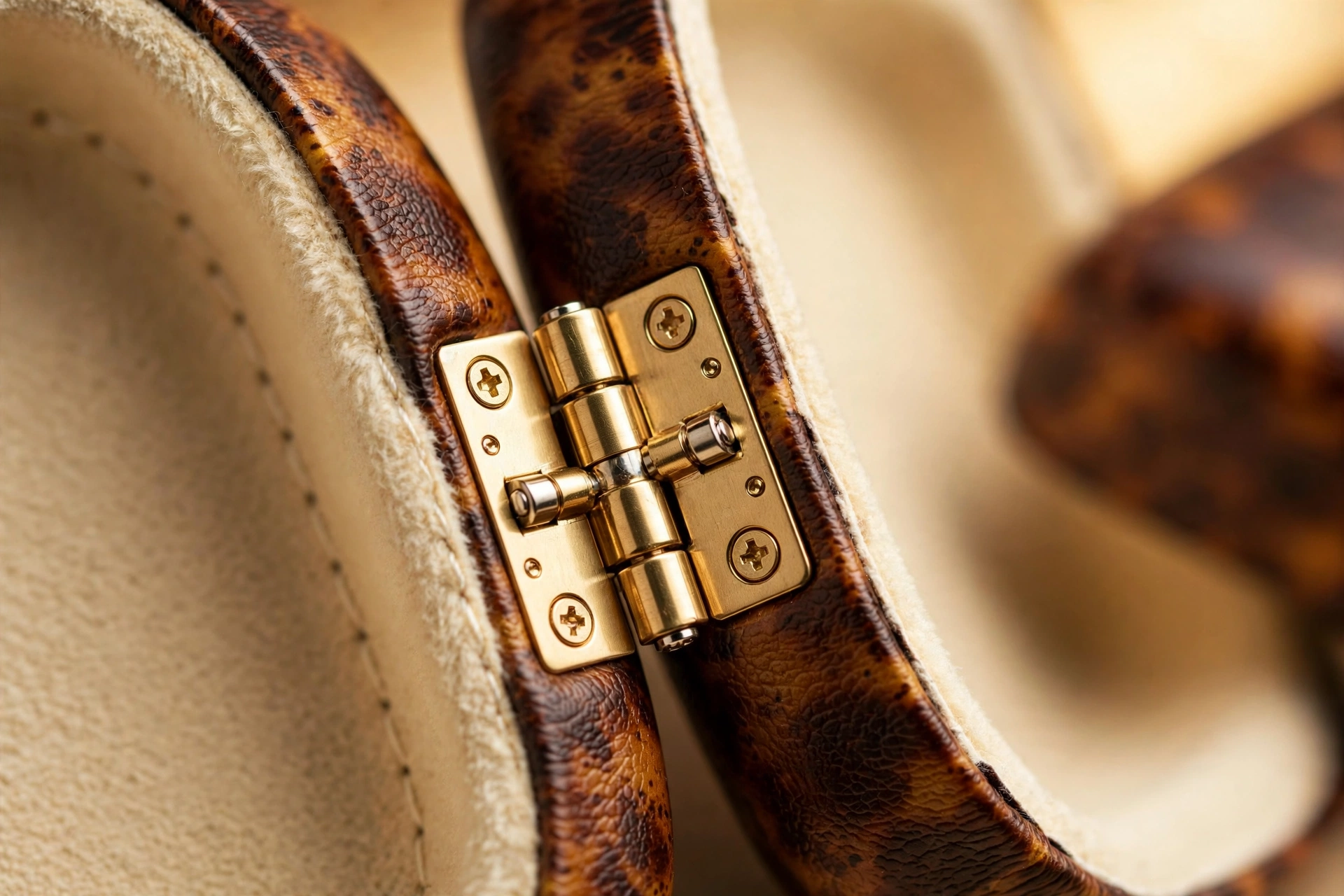
Brass hinges, ten thousand folds
The mechanism is the moat. Two polished brass hinges carry the whole tri-fold — left panel folds onto center, right panel folds over, clasp locks all three. Toleranced pivots keep panels aligned for a decade of folding.
- Solid brass, not plated plastic — the hinge is the product
- Fold sequence engineered: cavity faces meet flat, never lens-to-lens
- The fold is the ritual: open, display, close

Lens touches nothing hard. Ever.
This is the whole engineering brief in one photo. Each pair nests into a recessed cavity — lens surfaces sit at or below the panel plane — so the tri-fold closes flat, plane on plane. The lens rests only on cream microfiber: no foam edge, no plastic, no neighboring frame.
- Recessed cavities — the fold closes without lens-to-lens contact
- Each frame shape gets its own cavity negative
- Temples cradled — hinges never take the load

Brass clasp, watch-buckle feel
The margin detail. A solid brass clasp clicks shut like a watch buckle — the sound alone tells the customer this case costs more than the frame did.
- Solid brass, hand-polished
- Audible click — the premium cue
- Your logo debossed on the clasp plate
Picked to protect lenses
and justify price.
Every material here serves two masters: the lens inside, and the customer's willingness to pay.
- Shell — molded EVA, tortoise
- Why: the eyewear fashion signal. Tortoise is the industry's own pattern language — the case looks like it belongs to the product.
- Panels — rigid EVA, tri-fold
- Why: the mechanism is the moat. Three rigid panels on brass hinges fold into a slim case, open into a counter display.
- Cradles — die-cut EVA, 3 cavities
- Why: aviator, round and rectangular each get their own negative. Zero rattle, zero pressure on hinges, minimum case volume.
- Hinges & clasp — solid brass
- Why: the premium signal. Brass hardware is what separates a $15 case from a $60 case in the customer's hand.
- Lining — cream microfiber
- Why: the only thing touching lenses. Soft, lint-free, non-abrasive — foam alone would eventually mark coatings.
Every frame deserves
its own case.
Not "a glasses case" — a case designed for one frame, that makes that frame feel worth more. Find yours.
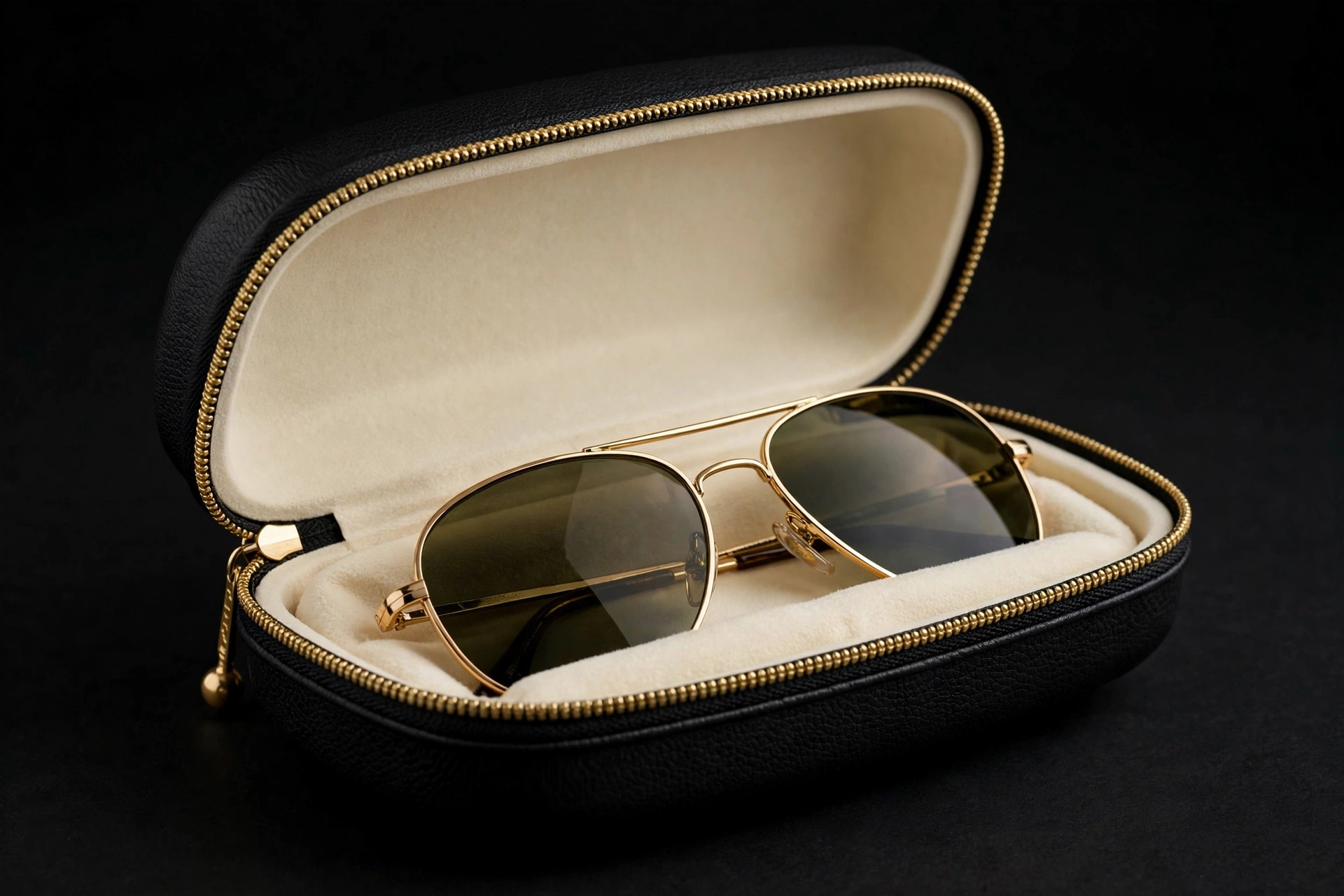
Aviator classic
Black shell · gold zipper · timeless
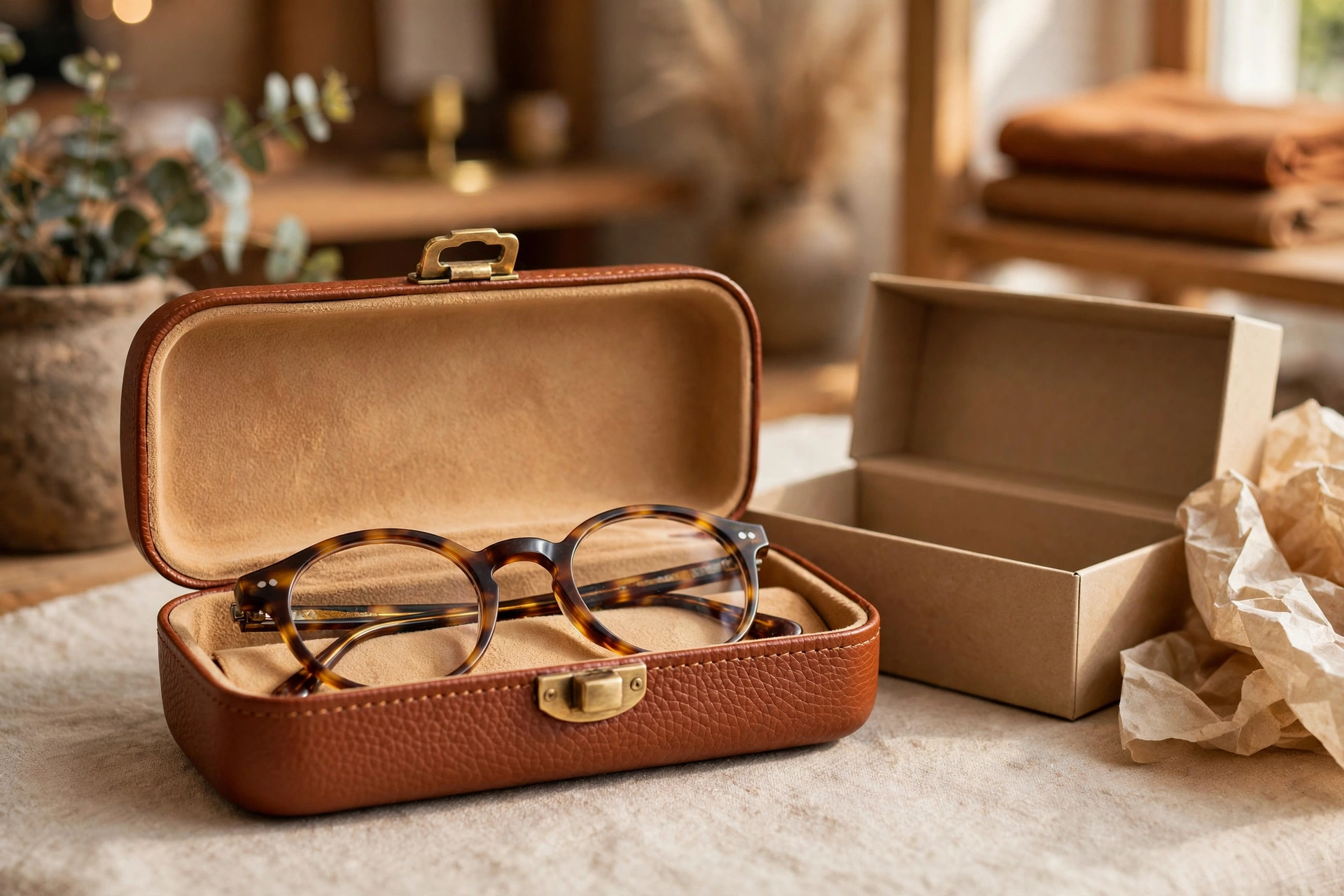
Round optical
Cognac leather-look · brass clasp · boutique
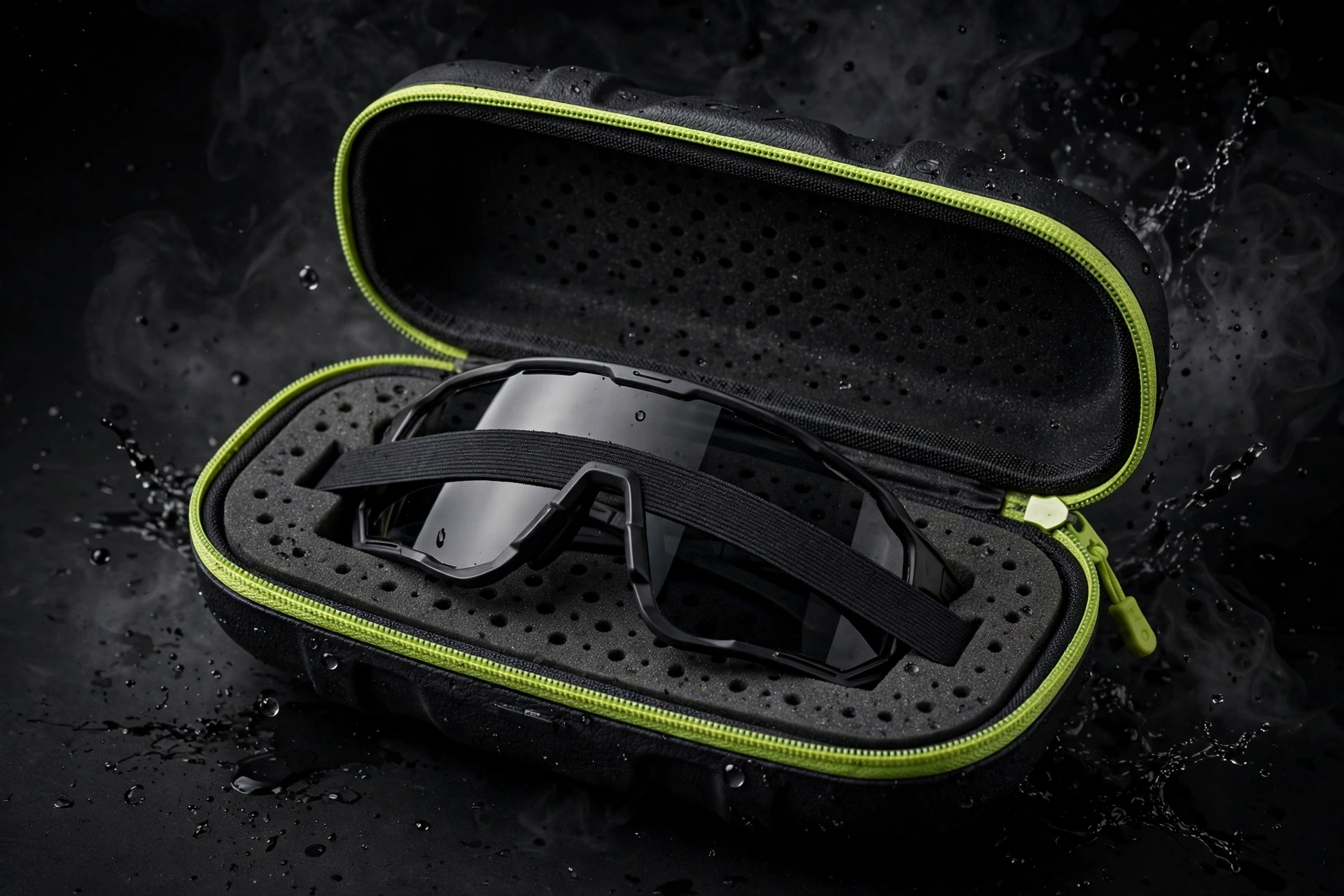
Sport wraparound
Matte black · lime accent · ventilated
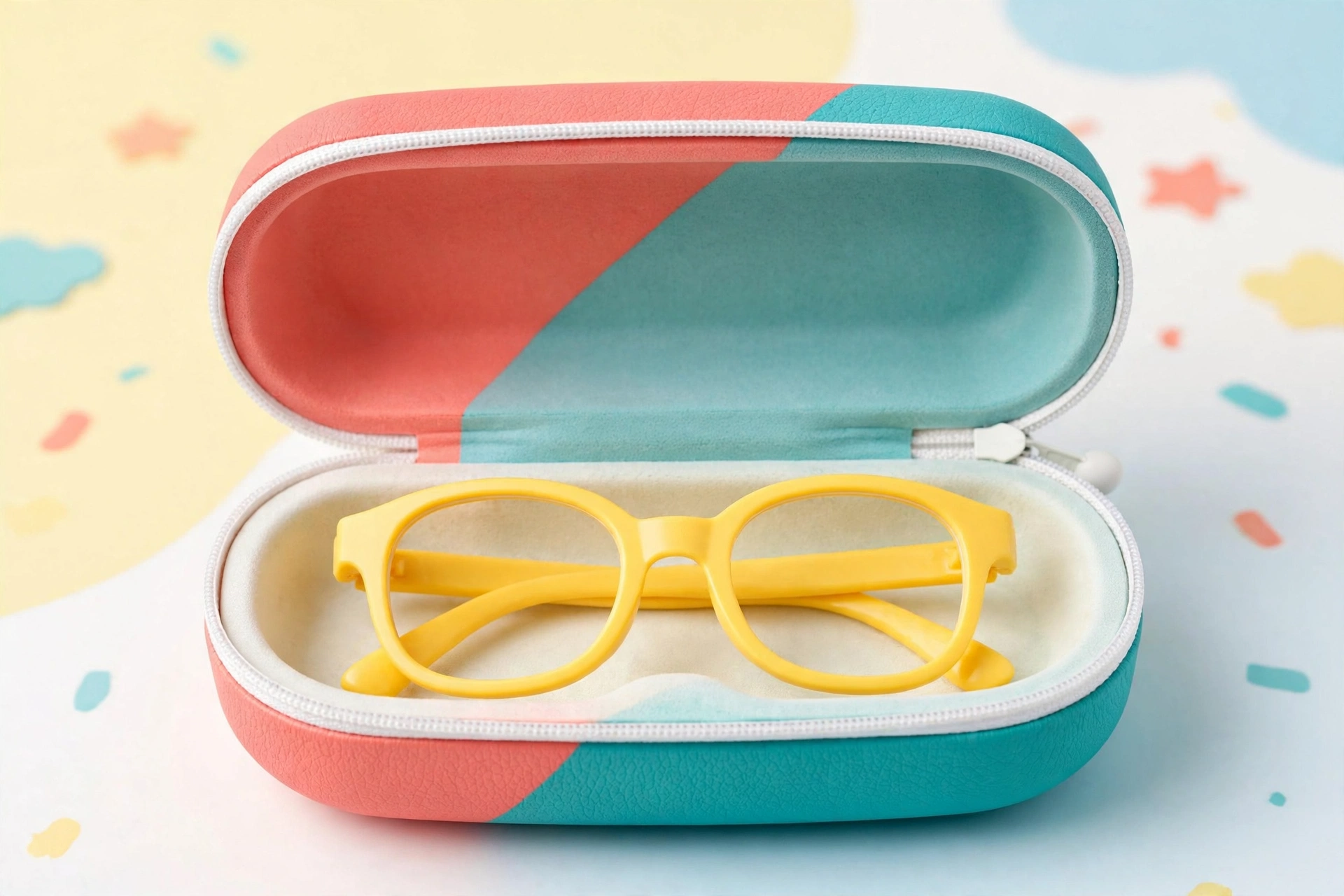
Kids frame
Coral & teal · extra padding · playful
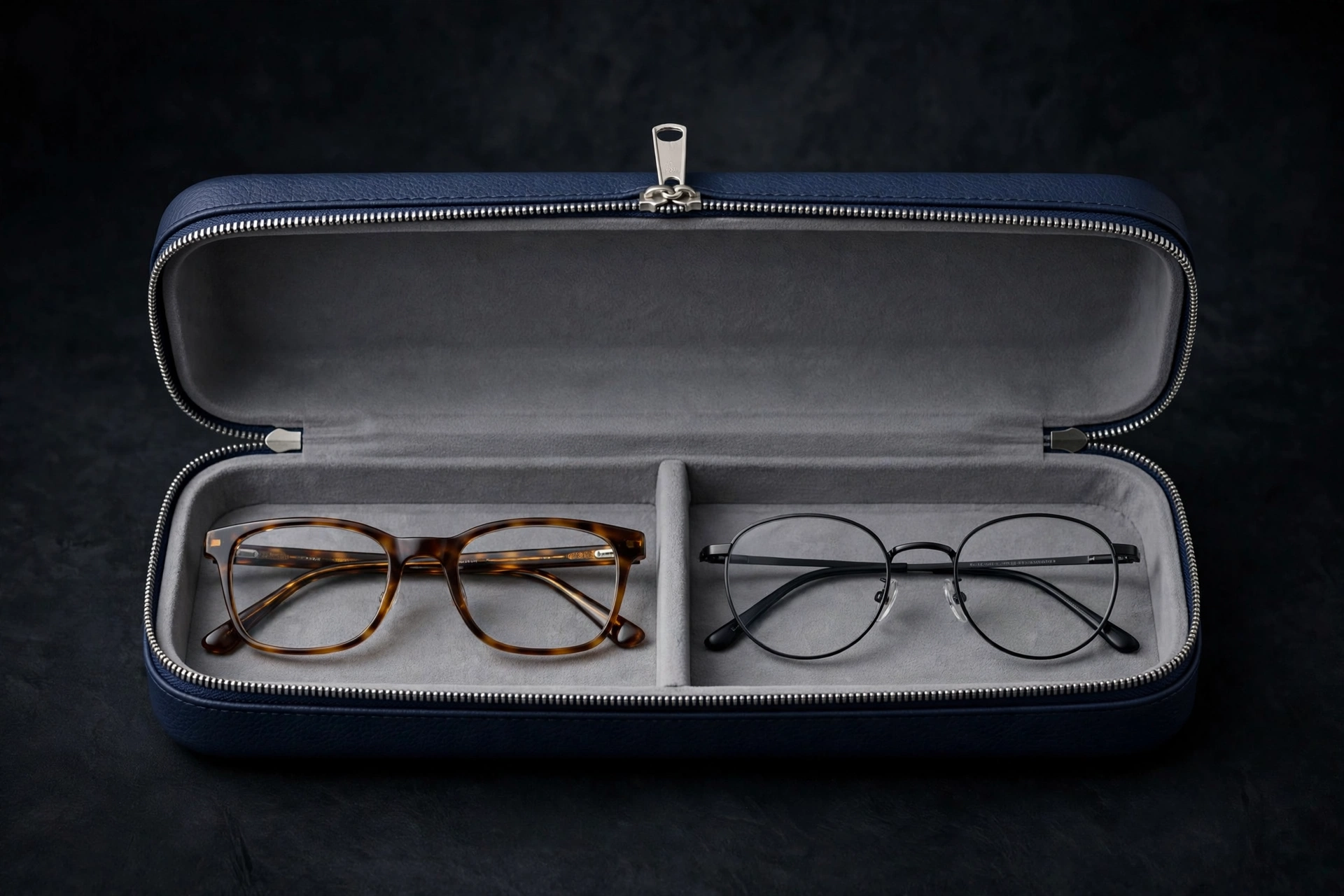
Double reader
Navy shell · twin slots · divider
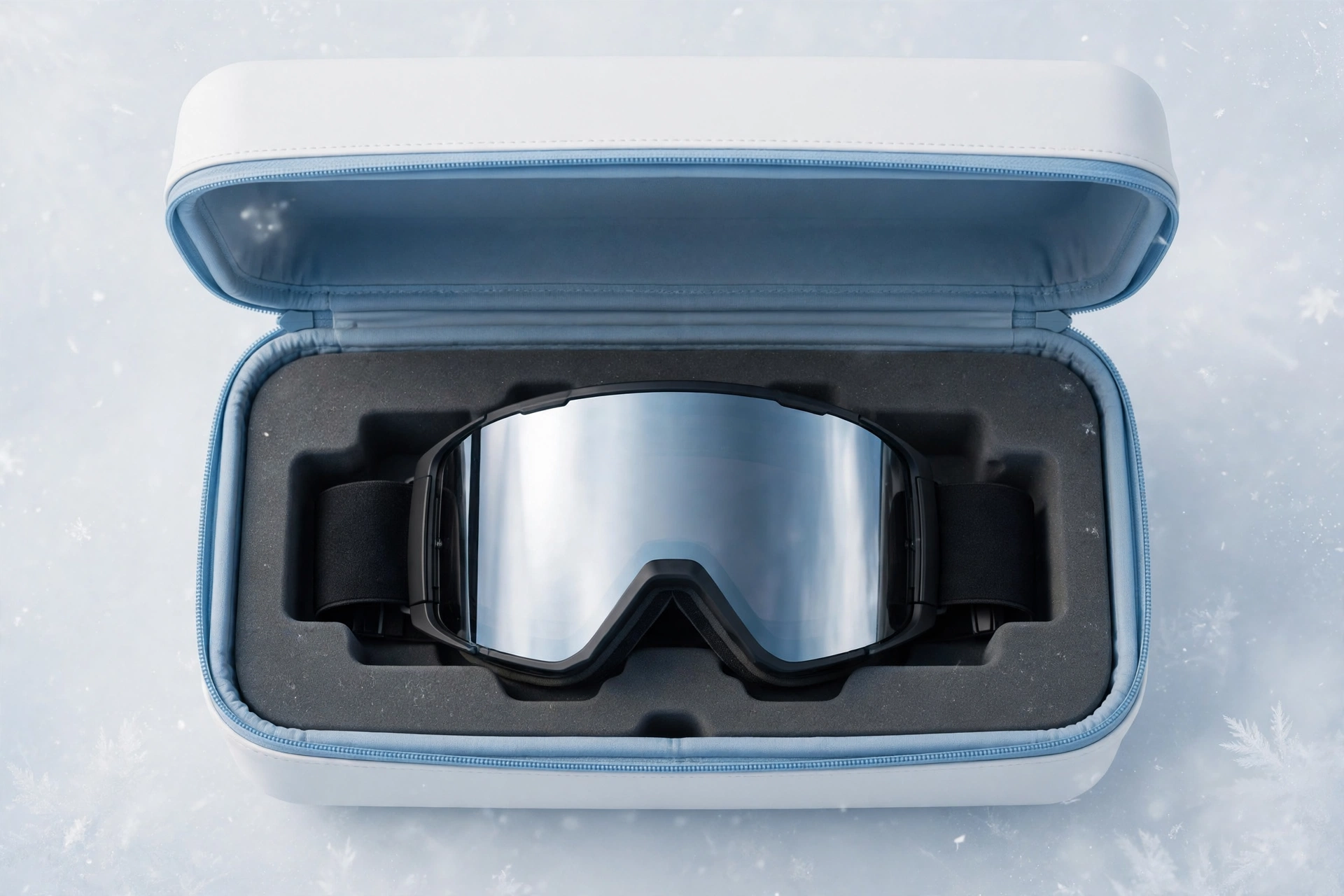
Ski goggles
White shell · ice-blue lining · oversized
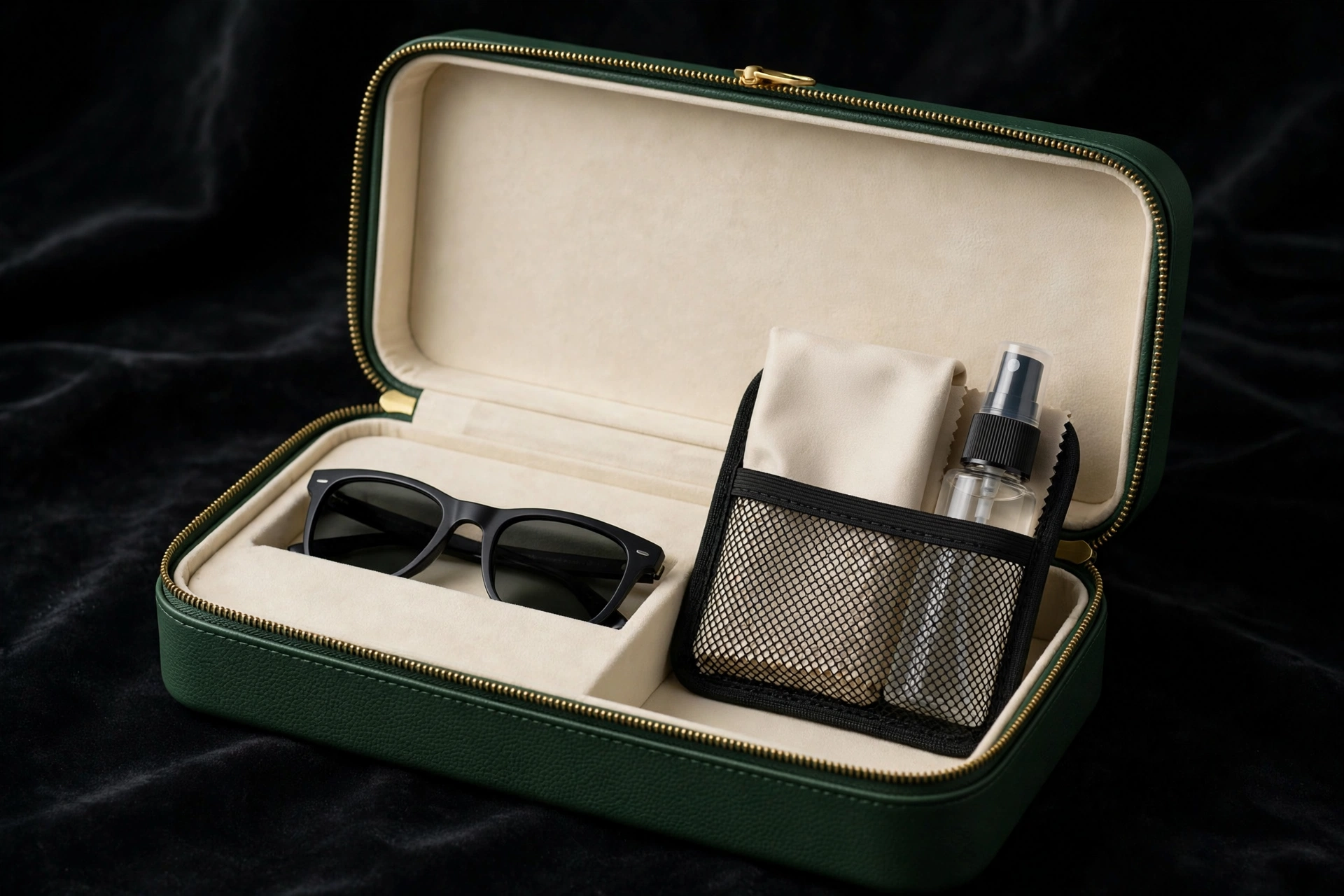
Care gift set
Forest green · brass zipper · full ritual
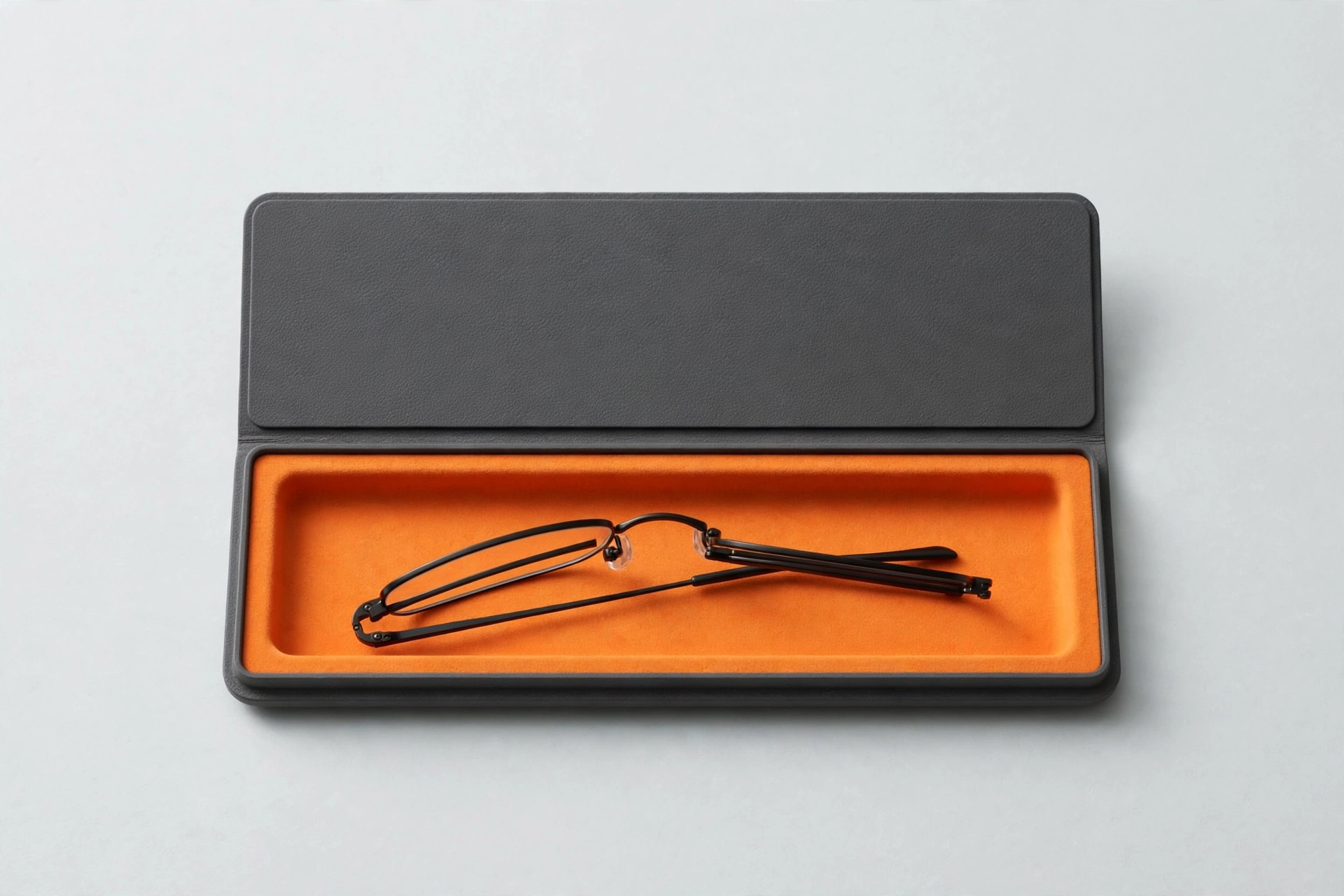
Slim folder
Charcoal flat · orange lining · pocketable
You don't need to know packaging.
Just tell us about your product.
Three questions about your product, its life, your brand — then we prescribe the build that raises its price tag.
What decides your case price.
We don't hide behind "contact for quote." Here are the four levers — tell us where you stand on each and the quote writes itself.
Case size & shape
Bigger shell, more material, more freight. A die-cut insert trimmed to your set — not a generic box — is the cheapest freight you'll ever pay.
Cradle complexity
Number of cavities, frame shapes, lining. Three different frame negatives cost more than one open slot — and scratch fewer lenses.
Materials & hardware
Brass hinges, brass clasps, microfiber lining — each is a premium signal with a price. We spec the finish to your target retail price.
Quantity
Custom starts at 1,000 pcs. Unit cost falls as volume rises — tooling is amortized, not repeated.
Five questions to ask any EVA factory.
Including us. Take this list to every supplier you evaluate — the answers tell you who actually engineers the fit.
- 1 · How do you verify die-cut tolerance?
- Good answer: caliper-checked against your product CAD, cavity by cavity. Red flag: "our standard sizes fit most products."
- 2 · Is the sample cut on production tooling?
- Good answer: yes — the sample die becomes the production die. Red flag: hand-cut samples that can't be repeated at volume.
- 3 · How do you test for lenses?
- Good answer: drop testing with your actual frames inside, checking for rattle in all directions. Red flag: no test, just "EVA is soft."
- 4 · What touches my lenses?
- Good answer: a named lining — microfiber, flannel — on every product surface, foam edges fully covered. Red flag: raw foam edges against coated lenses.
- 5 · What is the hardware rated for?
- Good answer: hinge and clasp cycle counts and a supplier spec. Red flag: "high quality hardware" with no number.
Numbers, not adjectives.
- Custom MOQ
- 1,000 pcs — real custom work starts here
- Sampling
- ~7 days — physical sample in your hands
- Mass production
- 15–25 days after sample approval
- Monthly capacity
- 100k+ pcs across 3 production lines
Asked by eyewear brands
An EVA glasses case is a hard-shell eyewear case made from heat-pressed EVA foam, with compartments shaped to the exact frame — so lenses never rattle, shift or touch anything hard.
Each pair gets its own microfiber-lined cradle — the lens touches nothing but soft lining — inside a rigid shell that absorbs drops before they reach the frame.
Yes — that's the point of custom. Each cavity is cut for one specific frame: aviator, round, rectangular or your own shape. Send us the frames or their dimensions.
That's the point. Tell us your target retail price and we'll spec the finish to match it — hardware, lining and trim are chosen to justify the price tag, not just to hold the product.
Typically 1,000 pcs. Samples in ~7 days, production 15–25 days after your approval.
Send us your product.
We'll make it worth more.
Frame dimensions, photos, or the actual frames — engineering feedback and a quote within 24 hours.
info@hcdcase.com