Custom EVA drone case,
engineered around every part that flies.
A drone is a $500 precision instrument riding in a $15 foam box. The Flight Deck changes the math: die-cut cavities for the folding drone, the controller with raised stick guards, three batteries in fire-isolated compartments, propellers in separated slots, cables in their own channels. Nothing rattles, nothing shorts, nothing warps. This case doesn't just carry a drone — it makes a $500 drone feel like a $1,000 pro rig.
- Die-cut drone cavities
- Fire-isolated batteries ×3
- Stick-guard controller slot
- Custom MOQ 1,000 pcs
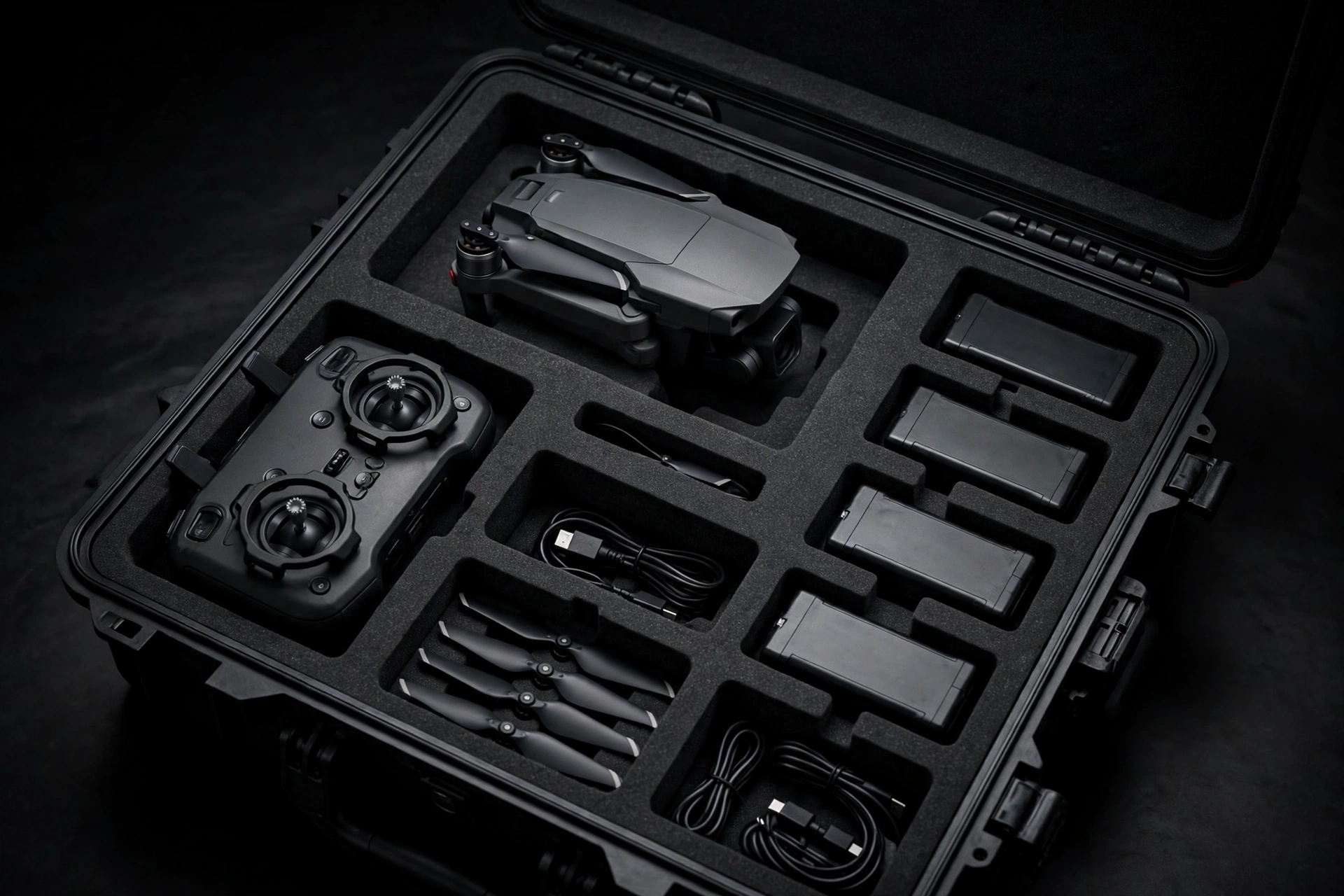
The four ways drone kits
get destroyed in transit.
A drone case has one brutal test: the kit arrives ready to fly. Most cases fail before takeoff.
"Loose batteries are a fire waiting to happen."
LiPo cells bouncing against metal tools in a generic case — every pilot knows the story. Our answer: each battery in its own fire-isolated compartment, separated from everything conductive.
"The controller sticks arrive bent."
One baggage-handler throw and the gimbal sticks take the full lid load. Our answer: raised foam stick guards — the controller nests below the foam plane, the lid can never touch the sticks.
"Pick-and-pluck foam crumbles in a season."
Pre-scored foam tears, sheds, and swallows small parts. Our answer: die-cut EVA cavities from your CAD — clean edges, exact fit, survives years of field use.
"Propellers warp and cables tangle."
Loose props bend against the shell; cables knot around the gimbal. Our answer: vertical prop slots and dedicated cable channels — every accessory has an address.
Pull it apart.
See what you're paying for.
Four layers. Tap each number — every layer answers one of the seven fit-engineering questions: volume, size, protection, rattle, lift, scratch, static.
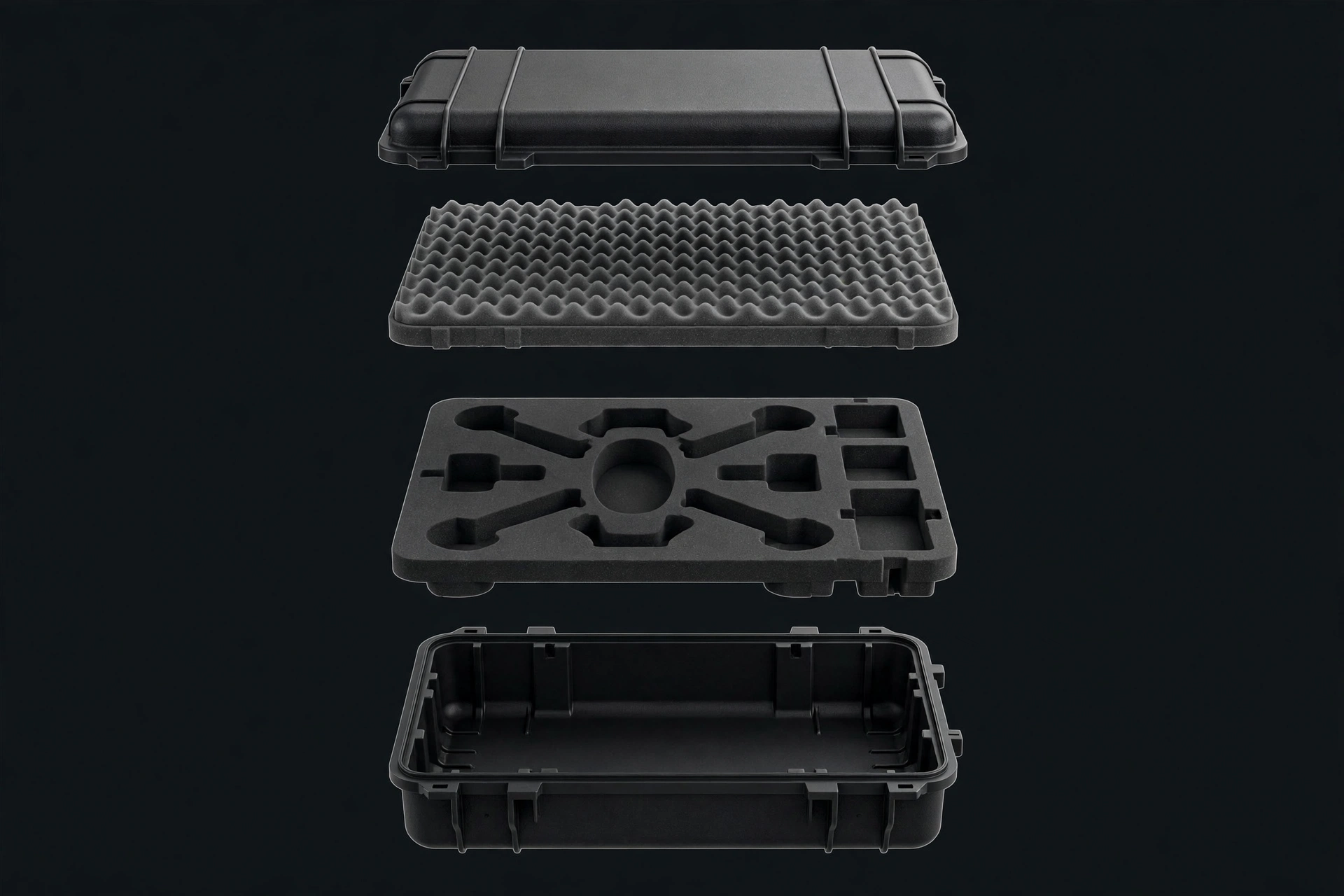
1 · Hard-shell lid
The armor. Heat-pressed black EVA — rigid, crush-proof, foil-stamped with your brand. Checked baggage can't hurt what's inside.
The details pilots pay extra for.
Three close-ups. A box is the baseline — these are the details that make it a flight case.
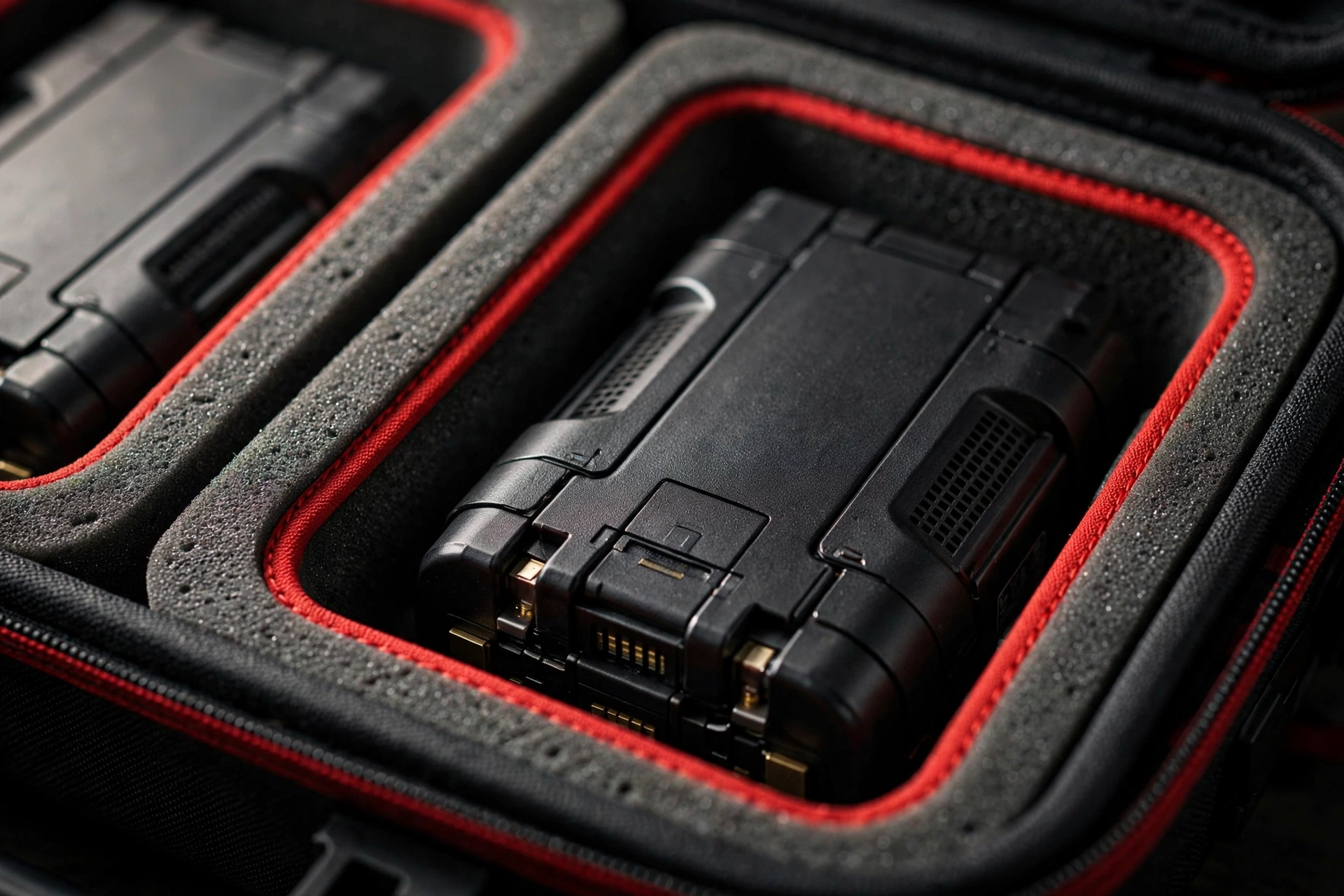
Fire-isolated battery bays
The detail that sells the case to anyone who's seen a LiPo fire. Each battery sits in its own compartment with fire-resistant lining — separated from the drone, the controller, and every other cell.
- One bay per battery — no contact, ever
- Fire-resistant lining in every bay
- Terminals face away from metal parts
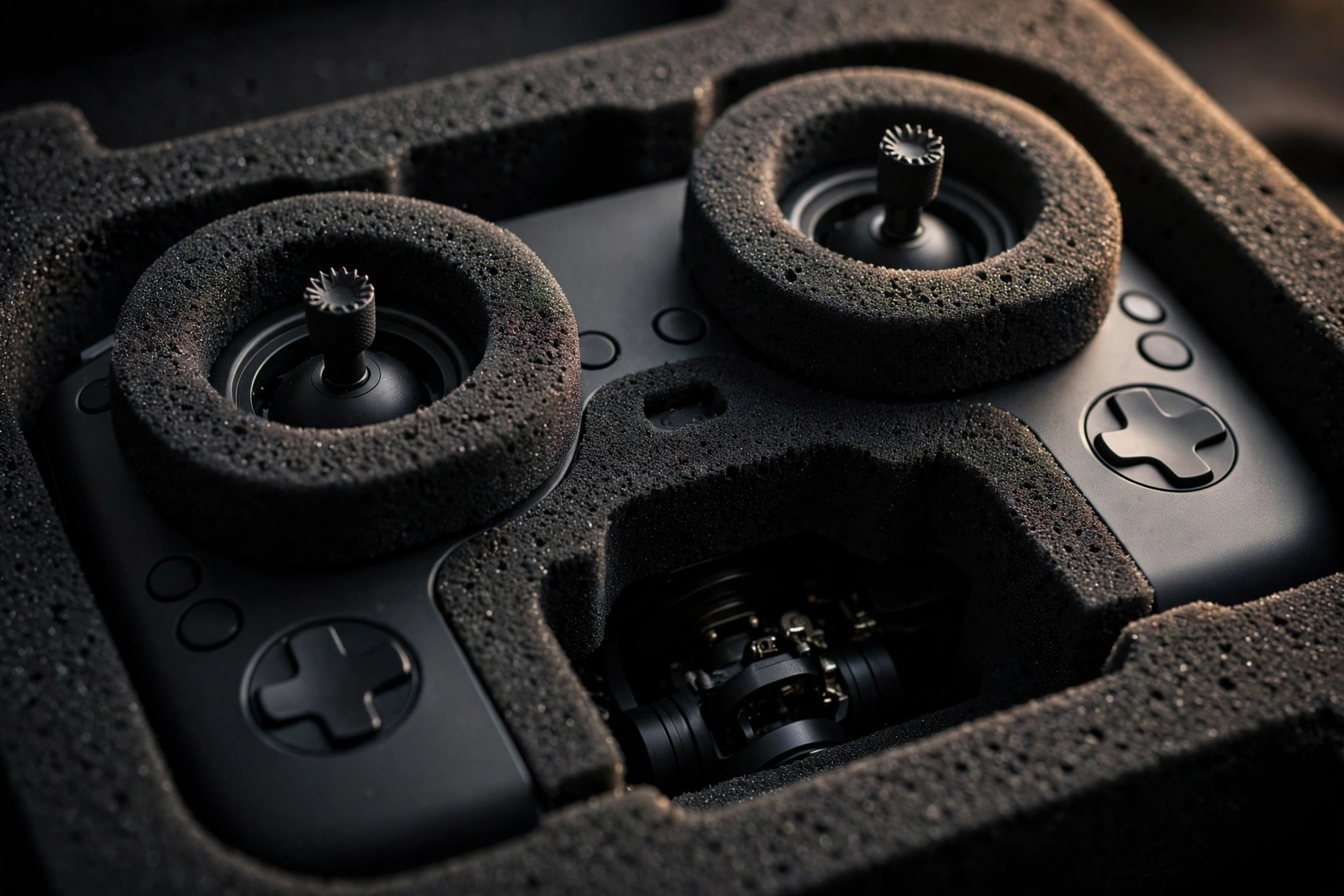
Stick guards — the gimbal never takes a hit
The most expensive two centimeters in the kit. The controller nests below the foam plane with raised guards ringing each stick — the lid closes onto foam, never onto the gimbal.
- Sticks sit below the close plane
- Raised guards take the lid load
- Zero stick drift from transport
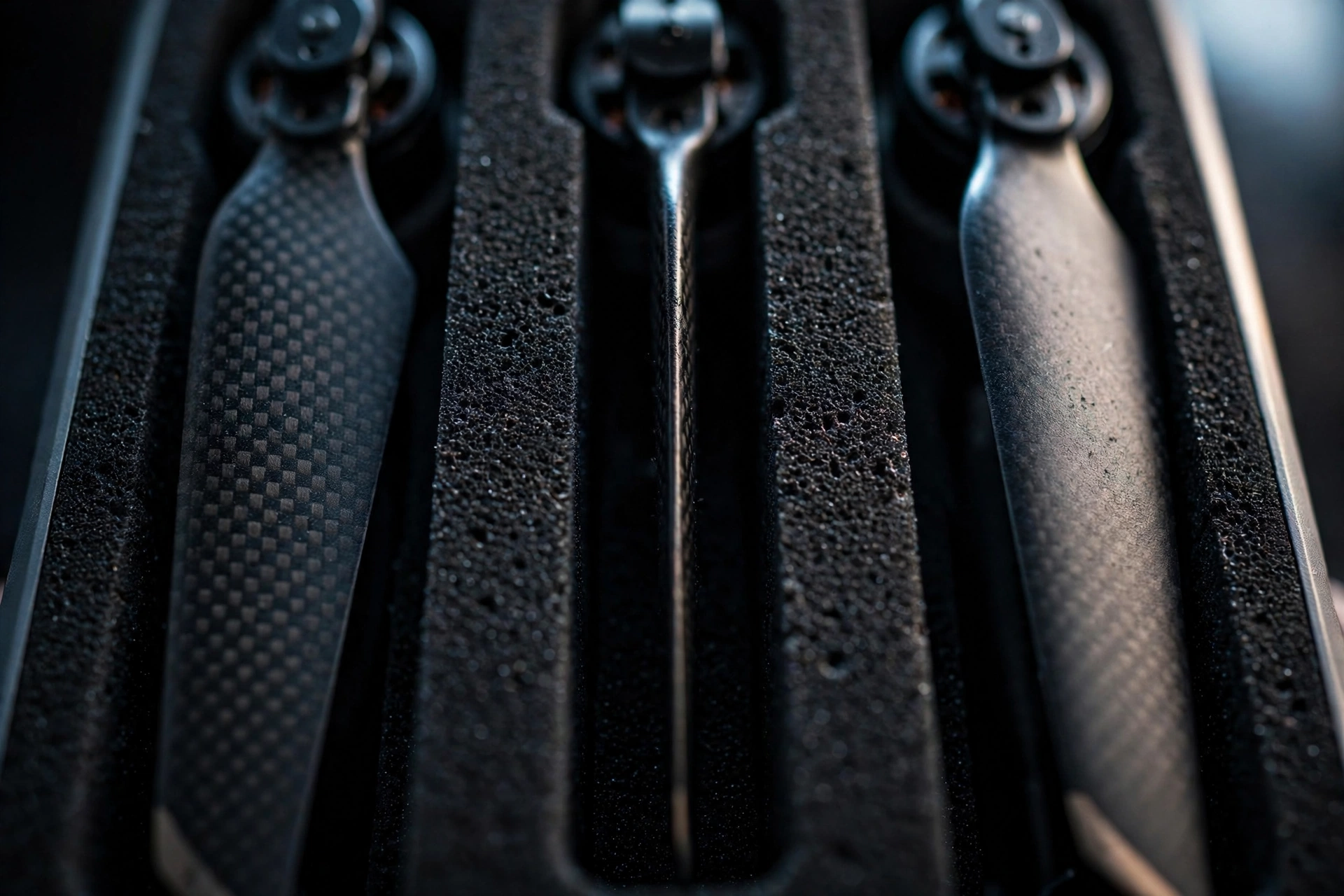
Prop slots — blades stay true
A warped prop is a crashed drone. Spare blades slot vertically into narrow die-cut channels — held straight, separated from each other, never bent against the shell.
- Vertical slots — no bending load
- Divided — blades never touch
- Sized to your prop diameter
Picked to survive
checked baggage.
Every material here serves one master: the kit that must arrive ready to fly.
- Shell — molded EVA, hard
- Why: the armor. Rigid heat-pressed EVA — crush-proof, drop-proof, the drone never feels the baggage belt.
- Tray — die-cut EVA foam
- Why: the engineering. Cut from your CAD — every cavity dimensioned to its part. Clean edges, exact fit, zero rattle.
- Battery bays — fire-resistant lining
- Why: the insurance. Each cell isolated from everything conductive — the detail that lets you ship with confidence.
- Lining — anti-static
- Why: the electronics demand it. Anti-static foam and fabric around the drone and controller — no discharge damage in dry transit.
- Finish — foil stamp, brand colors
- Why: the shelf signal. Your brand's language on the lid — the case sells the drone before it's opened.
Every drone deserves
its own flight case.
Not "a drone bag" — a flight case designed for one aircraft, that arrives ready to fly. Find yours.
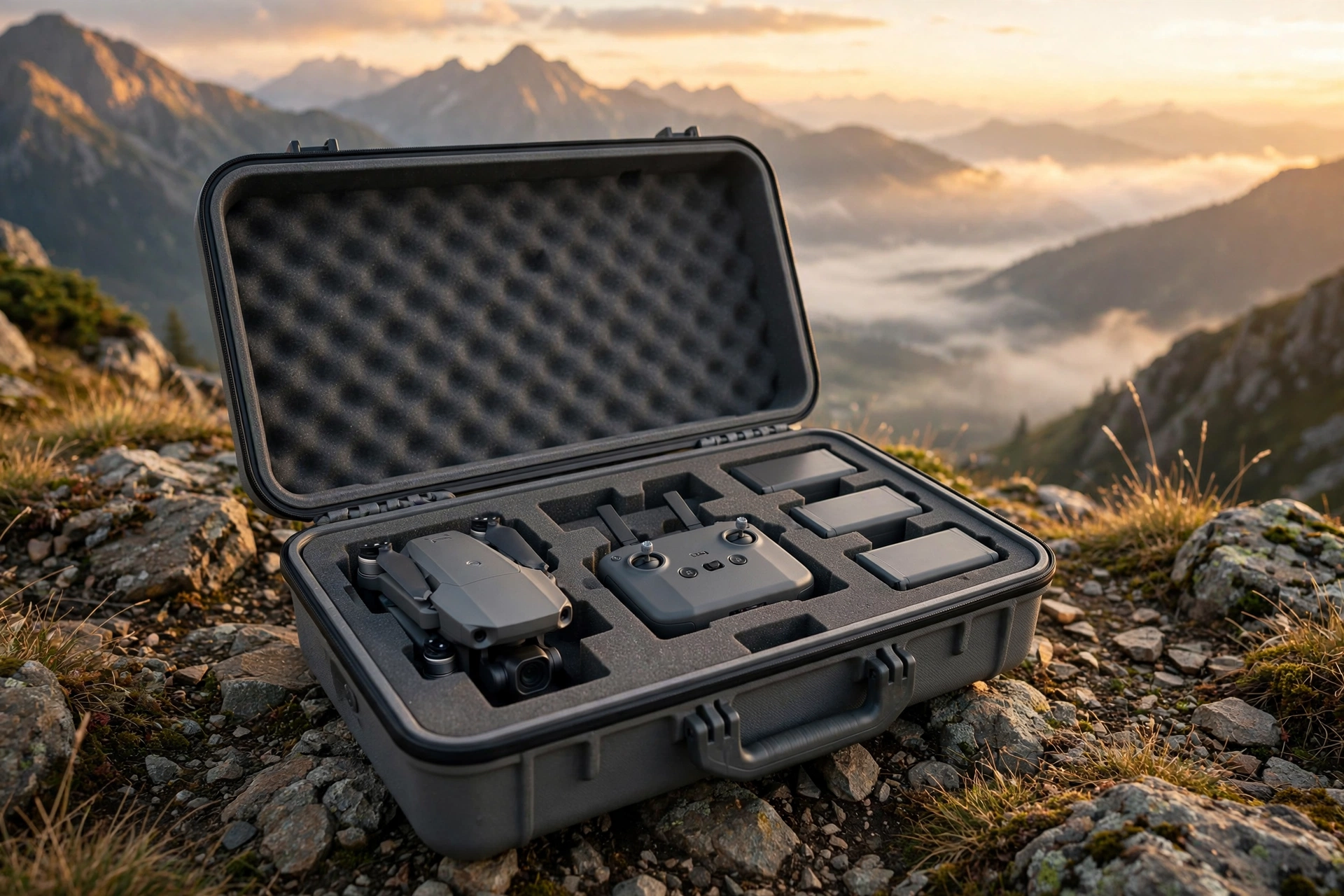
Camera drone travel
Foldable quad · die-cut · travel-ready
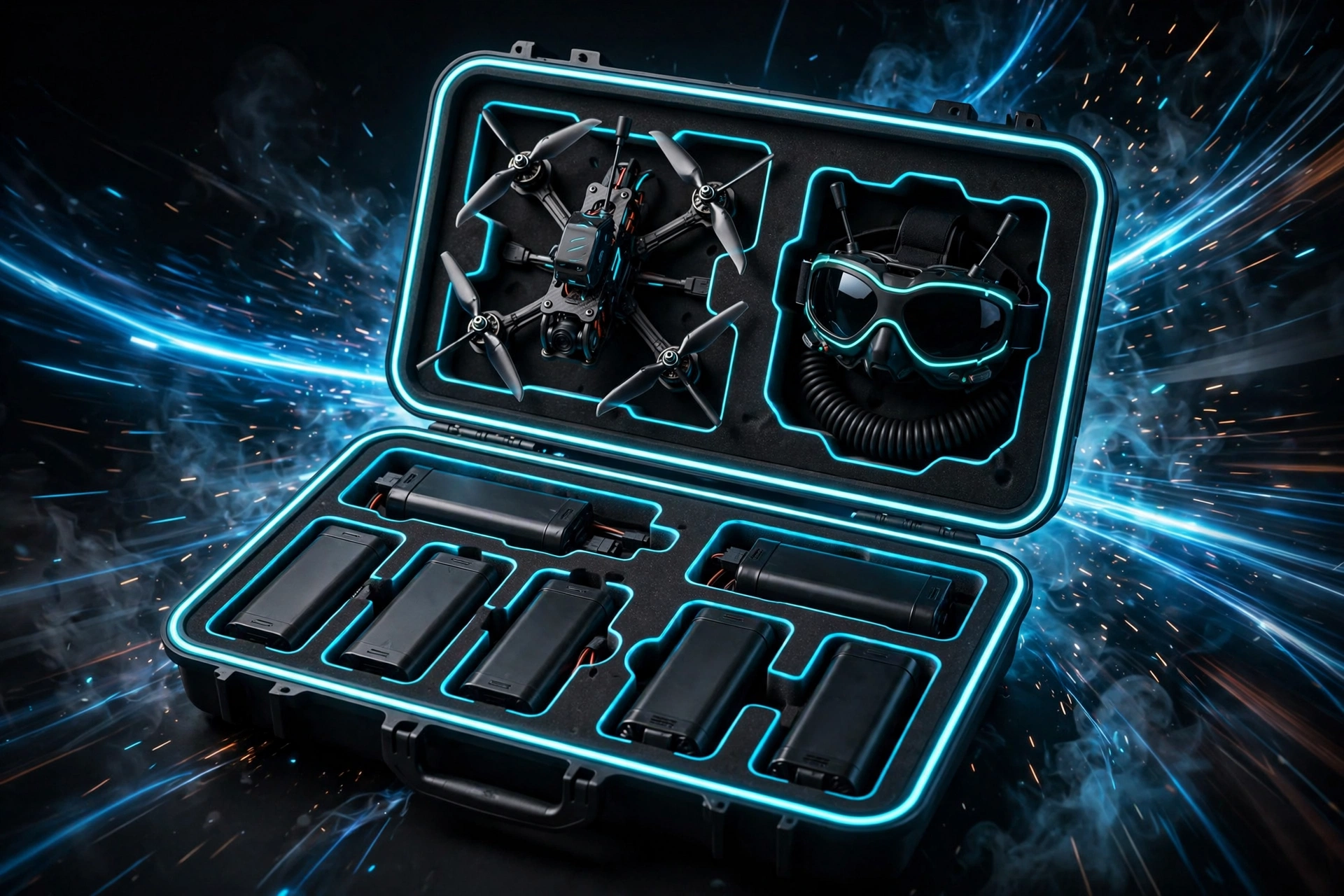
FPV racing kit
Drone + goggles · neon · race-tough

Mini selfie pouch
Compact · white · everyday
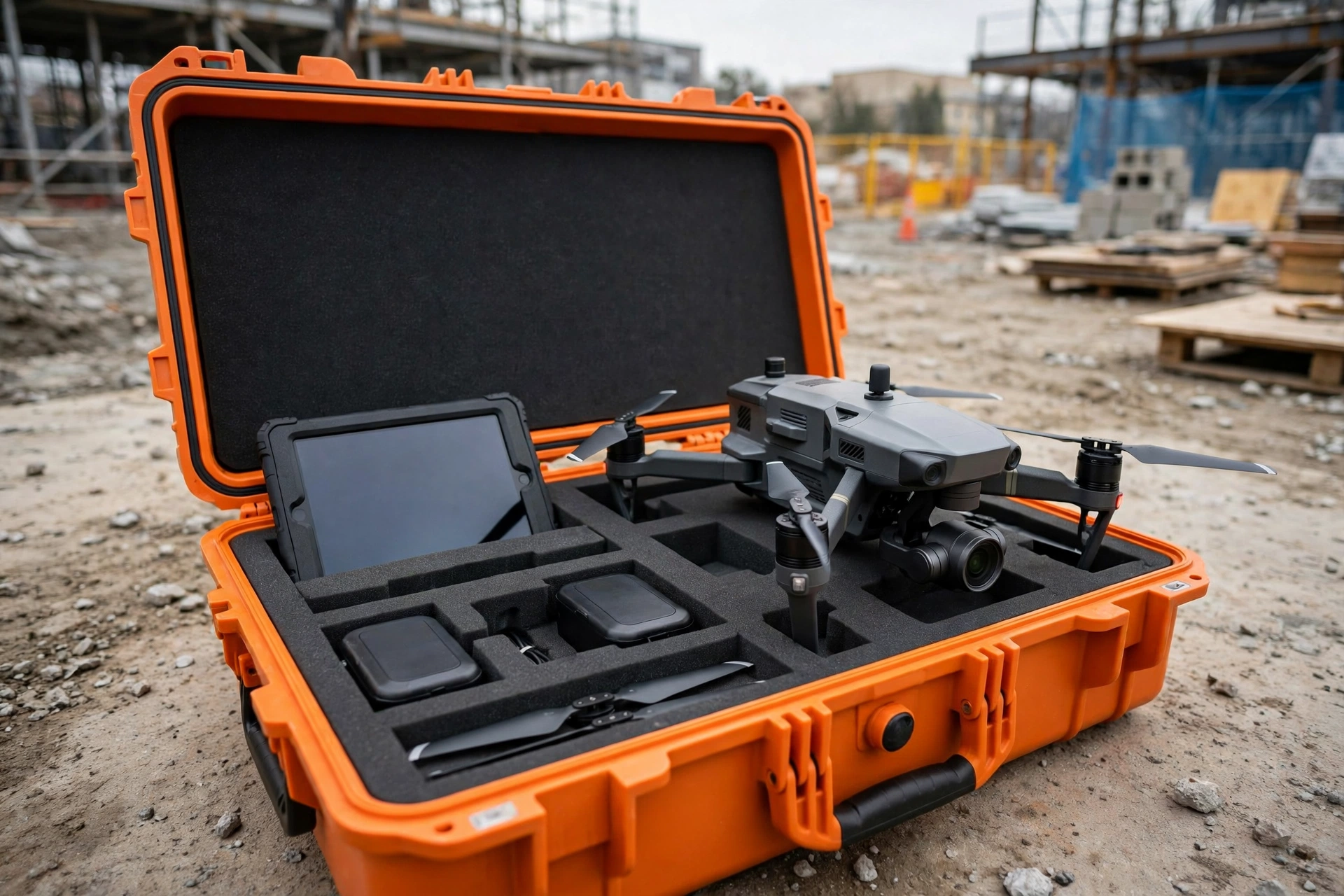
Inspection pro
Thermal cam · tablet slot · industrial
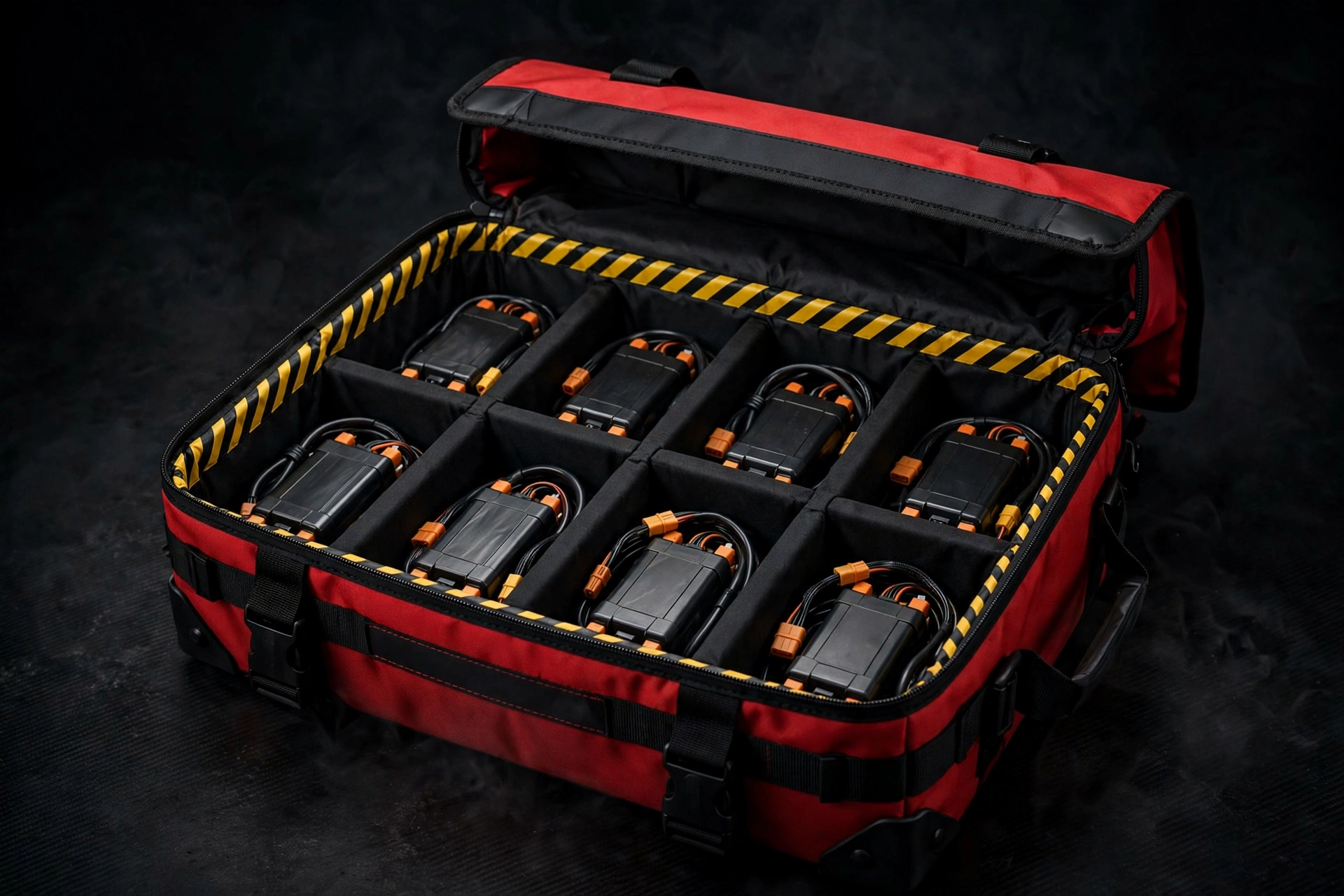
LiPo safe bag
Fireproof · isolated cells · warning trim
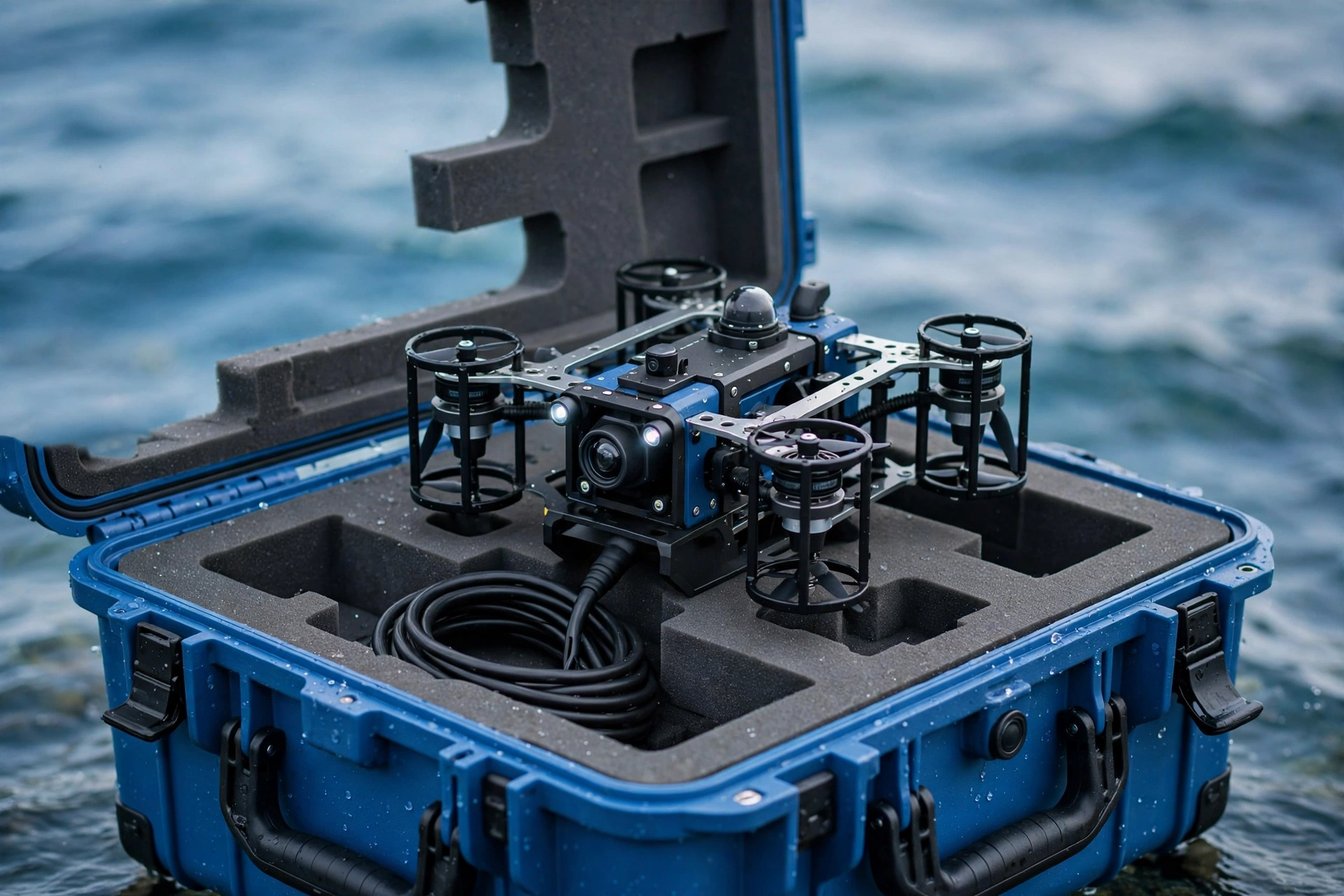
Underwater ROV
Waterproof · tether slot · marine
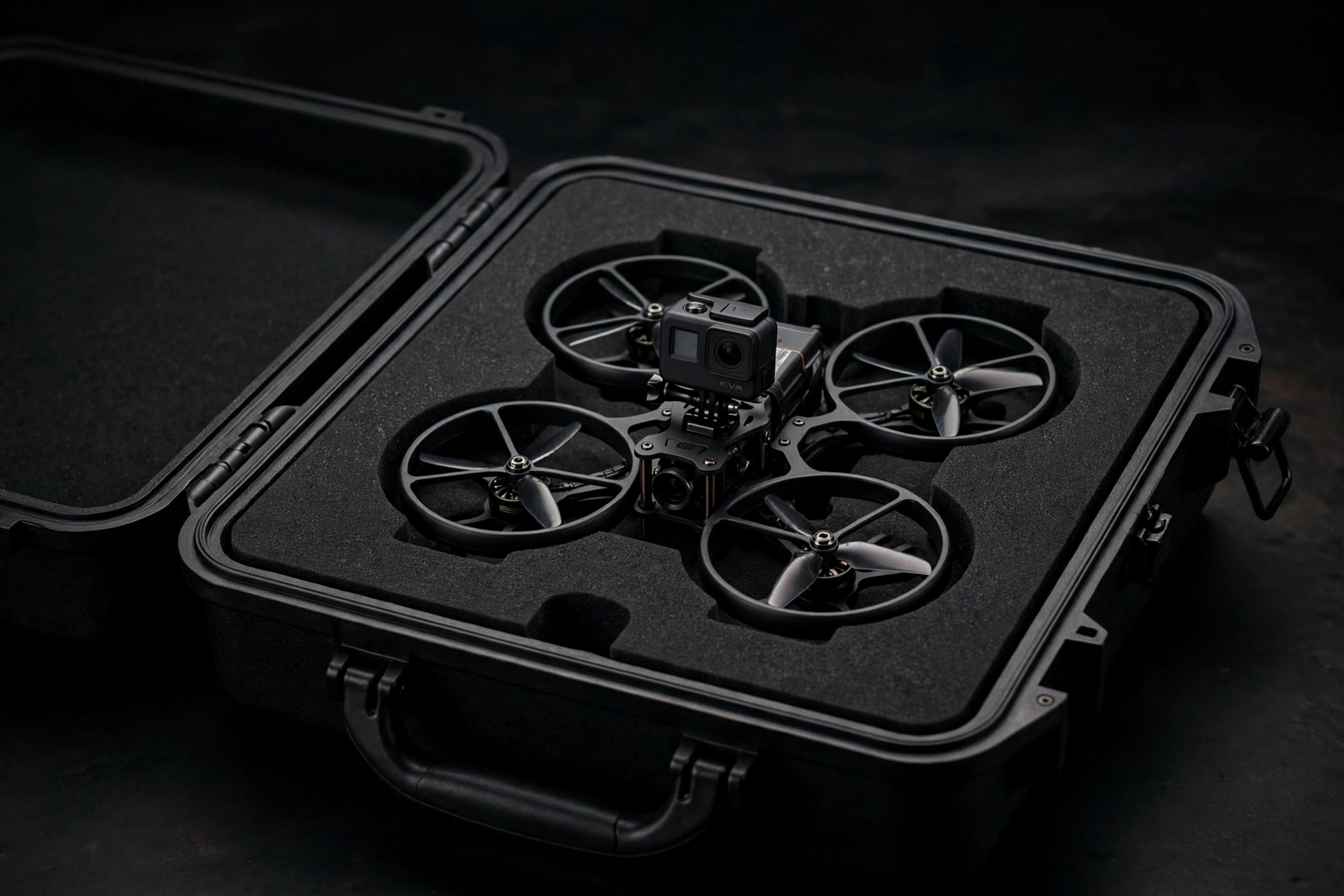
Cinewhoop stealth
Prop guards · action cam · compact
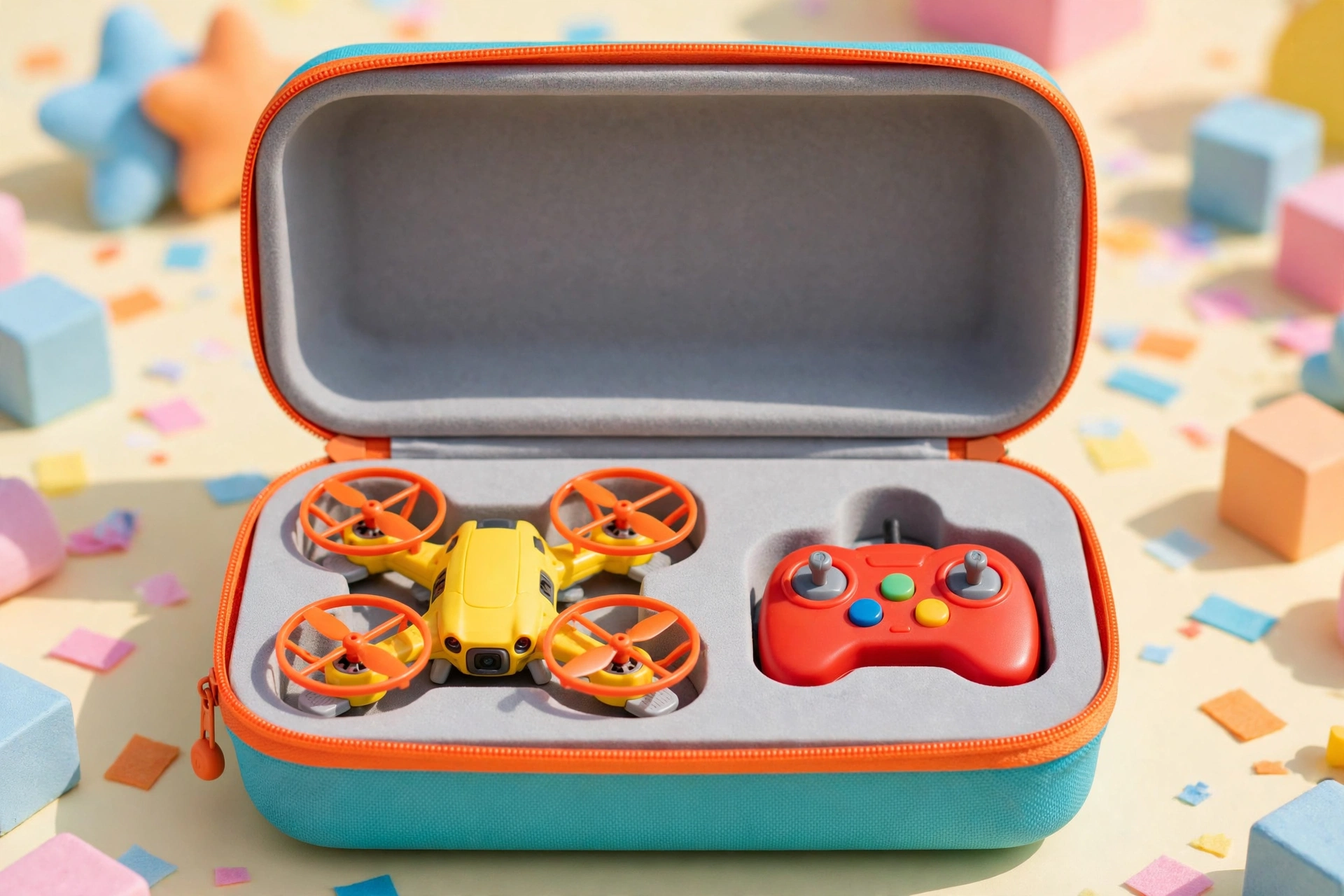
Kids toy drone
Rounded · colorful · drop-proof
You don't need to know packaging.
Just tell us about your product.
Three questions about your drone, its travel, your brand — then we prescribe the flight case it deserves.
What decides your case price.
We don't hide behind "contact for quote." Here are the four levers — tell us where you stand on each and the quote writes itself.
Case size & kit list
Bigger shell, more material, more freight. A layout trimmed to your kit — not a generic box — is the cheapest freight you'll ever pay.
Cavity engineering
Die-cut from CAD costs more than pick-and-pluck — and holds parts that foam cubes would drop. Stick guards and prop slots are precision, not padding.
Battery safety spec
Fire-resistant bay lining and cell isolation add cost — and let you ship, sell and fly with confidence. We spec it to your battery count.
Quantity
Custom starts at 1,000 pcs. Unit cost falls as volume rises — tooling is amortized, not repeated.
Five questions to ask any EVA factory.
Including us. Take this list to every supplier you evaluate — the answers tell you who actually engineers the fit.
- 1 · How do you isolate the batteries?
- Good answer: one fire-lined bay per cell, terminals away from metal, cells never touching each other or the drone. Red flag: "the foam holds them."
- 2 · Is the foam cut from our CAD?
- Good answer: yes — the sample die becomes the production die, dimensioned to your exact model. Red flag: "our standard insert fits most drones."
- 3 · What protects the controller sticks?
- Good answer: raised stick guards and a gimbal recess below the close plane — the lid can never press the sticks. Red flag: "the foam is soft enough."
- 4 · How does the kit survive a drop?
- Good answer: drop-tested with the full kit loaded — checking for part shift, stick damage and battery contact in all directions. Red flag: no test, just "EVA absorbs shock."
- 5 · Is the lining anti-static?
- Good answer: anti-static foam and fabric around the electronics — named materials, tested for discharge. Red flag: "it's foam, it's fine."
Numbers, not adjectives.
- Custom MOQ
- 1,000 pcs — real custom work starts here
- Sampling
- ~7 days — physical sample in your hands
- Mass production
- 15–25 days after sample approval
- Monthly capacity
- 100k+ pcs across 3 production lines
Asked by drone brands
An EVA drone case is a hard-shell protective case made from heat-pressed EVA foam, with die-cut cavities engineered around your drone kit — drone, controller, batteries, propellers — each part isolated so nothing rattles, shifts or shorts.
Each battery gets its own isolated compartment with fire-resistant lining — separated from the drone, the controller and each other, so a damaged cell can never take the kit with it.
Yes — the controller nests in a die-cut cavity with raised foam guards around each stick. The gimbal sits below the foam plane, so the lid can never press on it.
Yes — we cut from your CAD or sample unit. Every cavity is dimensioned to your drone, controller, batteries and accessories — not a generic grid.
Typically 1,000 pcs. Samples in ~7 days, production 15–25 days after your approval.
Send us your product.
We'll make it worth more.
Your drone model, kit list, or CAD — engineering feedback and a quote within 24 hours.
info@hcdcase.com